From Washington to Florida: What Happened in the Field?
Tomatoes surviving a reported fungal attack. Plums reaching 17–22 Brix. Dragon fruit moving through propagation faster. Squash producing more. Soil CEC increasing. These aren't hypothetical growing scenarios. They're field cases from farms across the United States.
Results shown throughout this article come from individual field cases. Conditions, crops, management practices and outcomes can vary by farm.
Let's Go to the Farm.
Agriculture has no shortage of big promises. Farmers hear them every year. More yield. Better quality. Fewer inputs. Stronger plants.
We think the more interesting question is: what actually happened when the technology reached the field?
Harvest Harmonics has worked with crops in the United States under dramatically different growing conditions, from Washington near the Canadian border to California orchards and Florida production. The cases below don't all measure the same thing, and that is exactly what makes them interesting.
Some focus on yield. Others on crop quality, soil measurements, propagation speed, input use or plant response under stressful conditions. Together, they give farmers something much more useful than a slogan: real examples to investigate.
Brix Reported in California Plums
Reported CEC Increase in Washington Tomato Soil
Peppers Reported Per Plant at Edible Acres
Rapid Squash Vine Growth Reported in Washington
Washington Put the Technology Through a Workout.
Washington produced some of the most varied Harvest Harmonics field observations in the United States: tomatoes under disease pressure, peppers with high Brix, rapidly growing squash and measurable changes in soil Cation Exchange Capacity.

The Tomatoes That Made It Through
At Edible Acres, heirloom tomatoes treated with Crop Booster went through a period of low light combined with a reported fungal attack.
According to the field case, all untreated control plants died while all treated tomato plants survived. When light levels improved a couple of weeks later, the surviving plants resumed growth and began producing fruit.
The specific fungal organism, plant counts and disease-severity measurements were not supplied, so this is best understood as a compelling field survival observation, not a claim of universal disease resistance.

What Happened Below Ground?
An eight-week soil analysis began with an initial CEC measurement of 18.3 meq per 100 grams of soil.
The case reported an 8.6 meq/100 g improvement, mathematically equivalent to approximately 47% relative to that initial value.

Five Weeks. A Lot of Vine.
In another Washington case, squash vines reportedly grew beyond the rows after only five weeks.
Production was reported at approximately 15% above previous years, while upward vine growth reached roughly three feet.
And Then There Were the Peppers.
A Washington pepper case reported 15–20 peppers per plant, with approximately 80% fully grown.
Brix was reported at 10 compared with the farm's normal range of approximately 5–7.
Plants were also reported to remain blooming with woody stems late in the production period.
Faster Growth Meets Fruit Quality.
California cases show a different side of the technology: propagation speed, fruit quality and reduced crop-input applications. Two particularly interesting examples came from dragon fruit and plums.
What If Propagation Didn't Take So Long?
In a California dragon fruit case, Crop Booster-treated plants were reported to move through propagation substantially faster.
One-gallon plants reached transplant size in roughly 2–3 weeks compared with 5–6 weeks, while five-gallon plants reached the target stage in about 5 weeks compared with 10 weeks.
Rooting was also reported faster, and overall plant growth was described as approximately 100% greater.

Sweeter Fruit. Fewer Applications.
In a California plum case, fruit from the treated field was reported at 17–22 Brix compared with the farm's normal range of approximately 15–17.
The case also reported one crop-input application compared with three or more normally used, representing at least 66.7% fewer applications.
Estimated input savings were approximately $74 per acre.
Sometimes the Interesting Result Isn't Yield.
One Florida observation involving wheatgrass, cucumber and periwinkle came during an unusual and stressful period surrounding Hurricane Irma. It did not produce the kind of clean yield table we would use for a production claim, but the field observation was still notable.

A Field Observation After Hurricane Irma
Wheatgrass, cucumber and periwinkle were part of a Florida comparison involving approximately ten seeds per variety per planter.
Following Hurricane Irma, the plants were reportedly unattended for five days. The source described control plants as having extremely heavy insect presence, while the Crop Booster plants were described as practically free of insects.
No insect counts, yield measurements or statistical analysis were supplied, so we treat this strictly as a qualitative field observation. But observations like these are exactly why further farm testing becomes interesting.
What These Cases Tell Us — and What They Don't.
Farm case studies are useful because they show what happened under real growing conditions. They are not, however, identical to large replicated scientific trials, and not every historical Harvest Harmonics case collected the same level of data.
When raw control values are available, we compare them. When a result is historical, estimated or observational, it should be described that way.
That doesn't make the results less interesting. It makes the next question more useful: what could happen on your farm, with your crop, your irrigation system and your management program?
Tell Us What You're Growing.
Harvest Harmonics offers a free farm consultation. Tell our team your crop, acreage, irrigation setup and what you're trying to improve.
Whether the goal is higher yield, better crop quality, reduced inputs, stronger plant development or simply understanding whether our technology makes sense for your operation, the conversation starts with your farm.
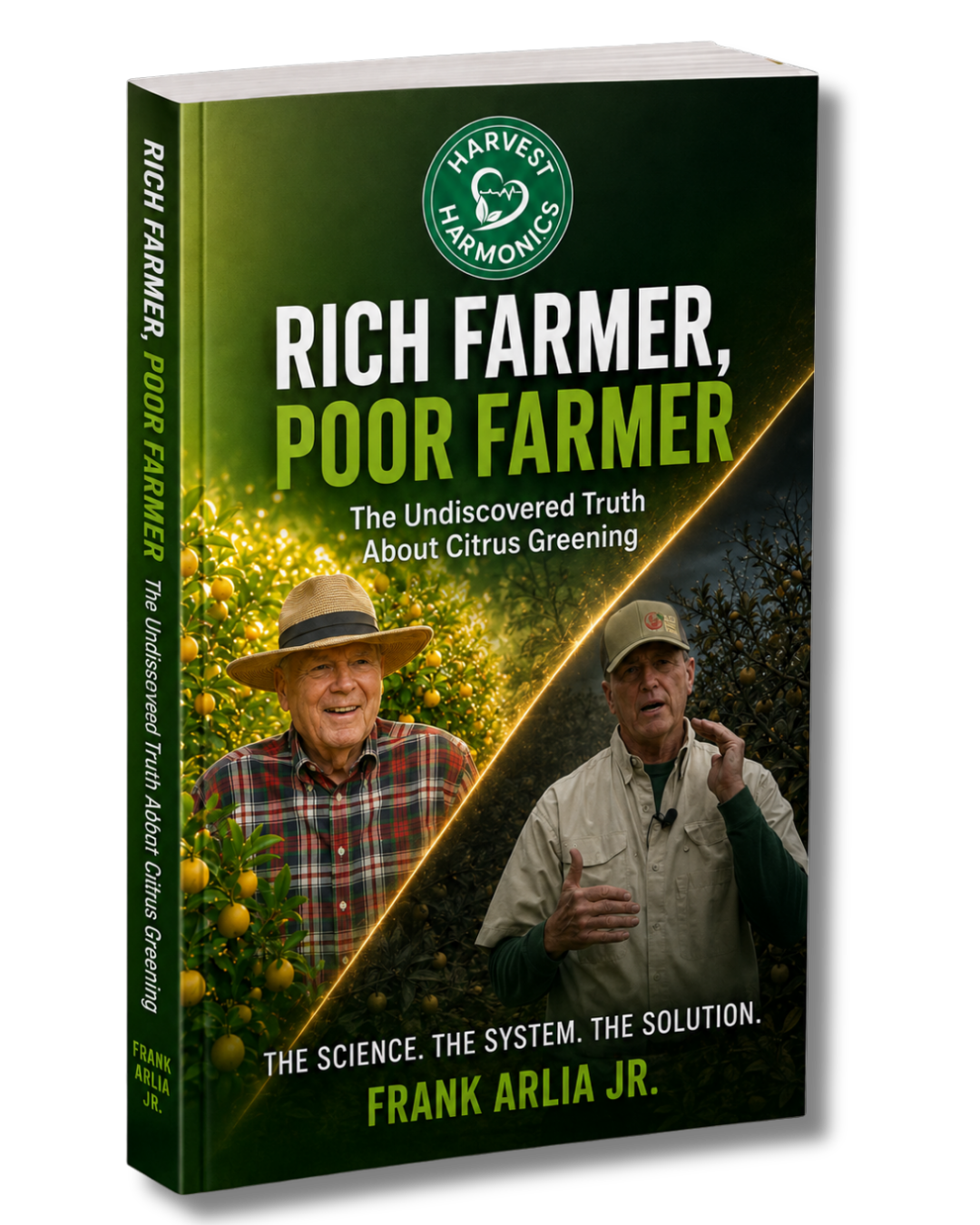
Rich Farmer, Poor Farmer
The Undiscovered Truth About Citrus Greening by Frank Arlia Jr. is now available for pre-sale.
The book takes a deeper look at citrus greening, the questions growers are asking and the path Harvest Harmonics believes deserves serious consideration.
Case-study results presented in this article reflect individual farms, crops, growing conditions and reporting methods. Some cases include measured treatment-versus-control data, while others are historical comparisons or field observations. Results can vary and should not be interpreted as a guarantee of identical outcomes on other farms. Individual case-study pages provide additional context about the available measurements and limitations.