

Broccoli
5,000 m² per treatment · March 2023
A government-backed field trial conducted by FIRA — Trust Funds for Rural Development, an agency of Mexico's federal government — at the Technology Development Center Villadiego in the Valle de Santiago, Guanajuato. The trial evaluated the Kyminasi Plants Crop Booster™ on the Super Diamante broccoli variety under drip irrigation.

| Measurement | Kyminasi (KPCB) | Control | Gain |
|---|---|---|---|
| Development leaves | Higher | Baseline | +6.2% |
| Leaf coverage area (photosynthesis) | Larger | Baseline | +12% |
| Avg head weight (g) ★ Top Result | 626.6 | 546.6 | +14.64% |
| Total tonnage yield | Higher | Baseline | +14.4% |
| Extra yield per hectare | +1.9 t/ha | — | 1.9 tons extra |
Location: Technology Development Center Villadiego, Valle de Santiago, Gto., Mexico · Date: March 2023
Variety: Super Diamante · Irrigation: Drip · Area per treatment: 5,000 m²
This trial was conducted by FIRA, a federal government agency of Mexico, lending institutional credibility to the results. KPCB-treated broccoli plants developed 6.2% more leaves with 12% greater leaf coverage — building a stronger photosynthetic base that translated directly into heavier heads. Average head weight increased by 14.64% (626.6 g vs. 546.6 g), and overall tonnage rose by 14.4%, equivalent to 1.9 additional tons of broccoli per hectare.
Questions? Schedule a Free Zoom Appointment →Ecuador · Broccoli
The Kyminasi Plants Crop Booster™ was installed on a commercial broccoli field in Ecuador. Both the KPCB-treated and control fields were planted on the same date. Forty-three days later, the growth difference between the two was clearly visible — and a mid-season hailstorm put the technology's stress tolerance claims to a real-world test.
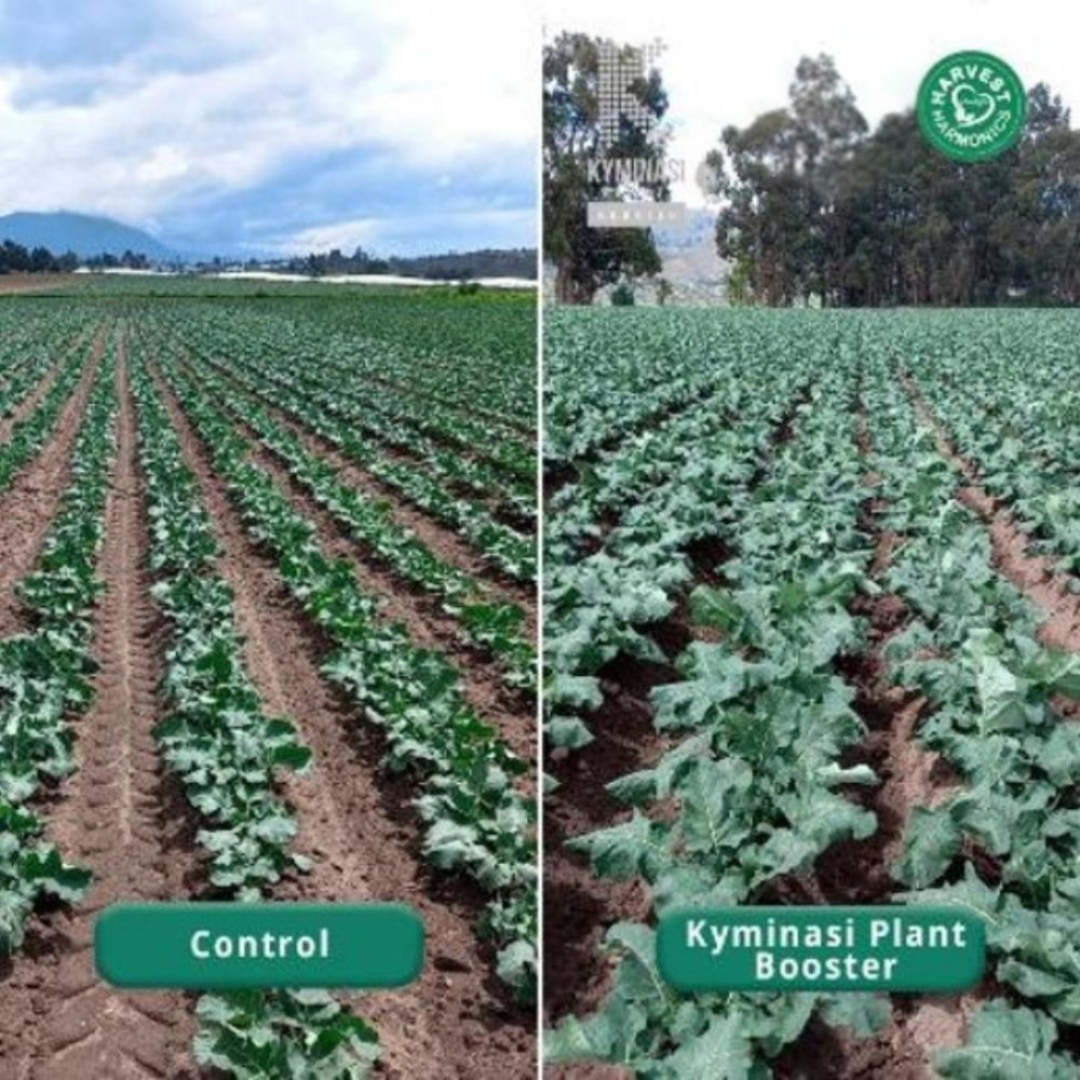
Trial Type: Commercial field — KPCB-treated field vs. untreated control, same planting date · Observation: 43 days after planting
This case study documents a qualitative outcome that goes beyond yield numbers: stress tolerance and plant resilience. Both fields started from the same conditions on the same date. By 43 days, the KPCB field had a visibly larger, more vigorous canopy. When a damaging hailstorm hit during the younger growth stage, it was the KPCB plants — with their enhanced vigor and stress tolerance — that survived and recovered. The photograph taken at 43 DAP makes the difference impossible to miss.
Questions? Schedule a Free Zoom Appointment →