

logologo

  • Home
  • Our Products
    • Yield Max Program
  • Results
  • The Science
    • TRL9
    • Science Documents
    • Science Documents (Spanish)
  • About Us
    • Global Representatives
    • Harvest Harmonics Video Gallery
    • Our Blog
    • Frequently Asked Questions
  • Contact Us
  • Cart
logologo

  • Home
  • Our Products
    • Yield Max Program
  • Results
  • The Science
    • TRL9
    • Science Documents
    • Science Documents (Spanish)
  • About Us
    • Global Representatives
    • Harvest Harmonics Video Gallery
    • Our Blog
    • Frequently Asked Questions
  • Contact Us
  • Cart
  • Home
  • Our Products
    • Yield Max Program
  • Results
  • The Science
    • TRL9
    • Science Documents
    • Science Documents (Spanish)
  • About Us
    • Global Representatives
    • Harvest Harmonics Video Gallery
    • Our Blog
    • Frequently Asked Questions
  • Contact Us
  • Cart

Corn

+255% Protein & +104% Maturity in Corn | Ocaña, Colombia | Harvest Harmonics
Home / Case Studies / Corn Quality — Colombia
Field Trial · Corn Quality · Colombia

Triple the Protein, Higher Sugars, Lower Acidity — Premium Corn.

In the same Ocaña corn trial, the Kyminasi Crop Booster didn't only save water and resist pests — it produced grain with 3.55× the protein, 35% higher Brix, and a maturity index more than twice the control, redefining what "quality corn" looks like.

+255%
Protein Content vs. Control
+104% Maturity
Index vs. Control
Date
September – December 2021
Location
Ocaña, Norte de Santander, Colombia
Crop
Corn — quality parameter trial
Inputs
Zero fertilizer · Zero pesticide
Field
Experimental Farm — UFPS Ocaña
Lab analysis
Protein, Brix, acidity, maturity index
Research Team Daniel Antonio Hernandez Villamizar & Luis Carlos Herrera Carvajal — Universidad Francisco de Paula Santander, Ocaña.
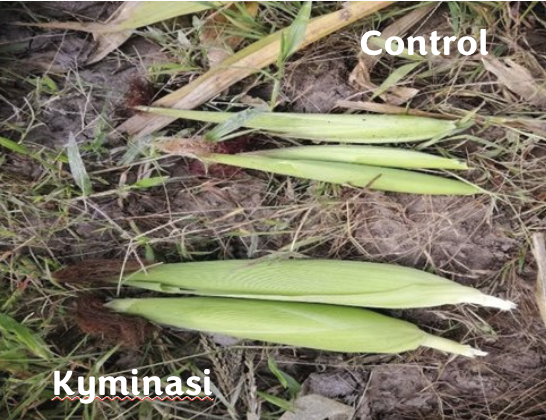
Corn grain quality comparison — Kyminasi Crop Booster vs. control, UFPS Ocaña, Colombia
Corn quality trial — UFPS Ocaña, Colombia · Sep – Dec 2021
Quality Results

A nutritionally denser, sweeter, more mature grain — from the same trial.

Lab measurements on the harvested grain show the KPCB field didn't just out-yield the control — it produced fundamentally different corn. Protein tripled, sugars climbed, harsh acidity dropped, and the maturity index more than doubled, meaning the crop reached premium quality faster and more completely.

3.70%
KPCB protein content
Versus 1.04% on the control — 3.55× higher protein density in the same grain.
11.57°Bx
Brix (sugar content)
Up from 8.57° on the control — sweeter, more palatable corn for feed and food markets.
4.62
Maturity index
More than double the control's 2.26 — the crop hit premium quality faster.

Triple Protein Density

3.70% vs 1.04% — corn that nourishes more per kilogram, valuable for both feed and food.

Mineral-Rich Grain

Mineral content lifted from 4.47% to 7.92% (+77%), pointing to deeper soil uptake.

Sweeter, Less Sour

Brix up 35%, titratable acidity down 33% — a meaningfully more palatable flavor profile.

Faster to Premium

Maturity index +104% — the crop reaches its peak quality window earlier in the cycle.

Quality Parameter KCB Control Gain
Protein content (%) 3.70 1.04 +255%
Brix — sugar content (%) 11.57 8.57 +35%
Titratable acidity (%) 2.49 3.76 −33%
Maturity index 4.62 2.26 +104%

Why this matters for corn growers: Most yield-focused trials say nothing about what's in the grain. This one does. Tripling protein and lifting Brix while dropping acidity — without fertilizer, without pesticide — points to a healthier plant that's actually pulling more nutrients from the same soil, and producing a grain that commands a premium in both feed and human-food channels.

Curious how a quality lift like this could change your buyers, your premiums, or your feed-conversion numbers? Let's talk through your operation in a free 15-minute call.

Schedule your free Zoom appointment
50% Less Water & 75% Less Pest Damage in Corn | Ocaña, Colombia | Harvest Harmonics
Home / Case Studies / Corn — Colombia
Field Trial · Corn · Colombia

Half the Water, 75% Less Pest Damage — Zero Chemicals.

At the experimental farm of Universidad Francisco de Paula Santander–Ocaña, the Kyminasi Crop Booster halved corn irrigation, cut pest damage by three quarters, and produced record yields — with no fertilizers and no pesticides applied at any point in the trial.

−50%
Water Consumption
−75% Pest Damage
vs. Control Field
Date
September – December 2021
Location
Ocaña, Norte de Santander, Colombia
Crop
Corn
Inputs
Zero fertilizer · Zero pesticide
Field
Experimental Farm — UFPS Ocaña
Comparison
Side-by-side KCB vs. control
Research Team Daniel Antonio Hernandez Villamizar & Luis Carlos Herrera Carvajal — Universidad Francisco de Paula Santander, Ocaña.
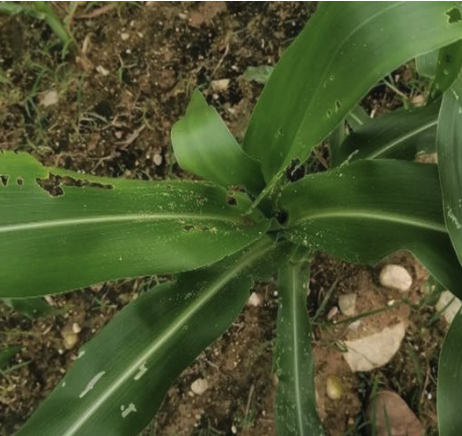
Corn field trial at Universidad Francisco de Paula Santander–Ocaña, Colombia — Kyminasi Crop Booster vs. control
Corn trial — UFPS Ocaña, Colombia · Sep – Dec 2021
Results

Record yields on half the water and none of the chemicals.

The KCB field consumed 94,770 liters of water against 189,540 liters on the control — a clean 50% reduction. Despite zero pesticide use on either field, the treated corn ended the trial with only 10% pest damage compared with 40% on the control: a 75% improvement, driven entirely by stronger plants.

94,770L
KPCB water use
Versus 189,540 L on the control — exactly half the irrigation volume to bring the crop to harvest.
10%
Pest damage on KPCB
Control field suffered 40% damage — KCB plants resisted pests with no pesticide use.
0inputs
Fertilizer + pesticide
Record-breaking yield achieved with no synthetic chemical inputs of any kind.

Critical Water Savings

50% less irrigation — meaningful in a region where water access and cost can decide profitability.

Input-Free Success

Zero fertilizer, zero pesticide — yet the treated field produced a record harvest.

Natural Pest Defense

Stronger plants resisted pest pressure on their own; pest damage held to 10% vs. 40%.

Academic Oversight

Trial designed and documented by researchers at UFPS Ocaña — independently verifiable.

Metric KPCB Control Change
Water consumption (L) 94,770 189,540 −50%
Fertilizer use 0 0 — same —
Pesticide use 0 0 — same —
Pest damage (%) 10% 40% −75%

Why this matters for corn growers: Halving irrigation water without compromising yield directly attacks the two biggest variable costs on a corn operation — water and chemicals. Achieving a 75% pest-damage reduction with no pesticide use also points to a plant-immunity story, not a chemical one — corn produced this way can fetch a premium in organic and reduced-input markets.

Curious whether you can cut water and chemical bills like this on your own corn or row-crop fields? Talk it through with our team in a free 15-minute call.

Schedule your free Zoom appointment
+55% Thicker Stems & Wider Leaves in Corn | Ocaña, Colombia | Harvest Harmonics
Home / Case Studies / Corn Architecture — Colombia
Field Trial · Corn Architecture · Colombia

Thicker Stems, Wider Leaves, Denser Canopy in Corn.

Measured at the 76-day harvest in Ocaña, Kyminasi Crop Booster corn plants had 55% thicker stems, leaves nearly a third wider, and 2.48 more leaves per plant than the control — building the structural foundation behind the trial's quality and pest-resistance gains.

+55%
Stem Thickness vs. Control
+2.48 Leaves
More per Plant
Date
September – December 2021
Location
Ocaña, Norte de Santander, Colombia
Crop
Corn — plant architecture trial
Inputs
Zero fertilizer · Zero pesticide
Field
Experimental Farm — UFPS Ocaña
Measurement
At final harvest, day 76
Research Team Daniel Antonio Hernandez Villamizar & Luis Carlos Herrera Carvajal — Universidad Francisco de Paula Santander, Ocaña.
Results

A structurally stronger plant — built from the inside out.

When researchers measured the corn plants at the 76-day harvest, the KPCB-treated crop wasn't just visually bigger — it was architecturally stronger. Thicker stems, wider photosynthetic leaves, and more of them per plant — the structural basis that explains the water savings, pest resilience, and protein density seen in the same trial.

2.76cm
KPCB stem thickness
Versus 1.78 cm on the control — a 55% thicker stem means a stronger, lodge-resistant plant.
9.08cm
Leaf width at harvest
Up from 6.89 cm (+32%) — wider leaves mean more sunlight captured per square meter of field.
11.64
Leaves per plant
Versus 9.16 on the control (+27%) — a denser canopy on every single plant in the field.

Robust Stem Architecture

Stems 55% thicker — better mechanical support, less lodging risk in wind & rain.

Wider Photosynthetic Surface

Leaves +2.19 cm wider (+32%) — meaningfully more sunlight captured per plant.

Denser Canopy

+2.48 more leaves per plant — better ground shading, lower weed pressure, more biomass.

Built Without Inputs

All gains achieved with zero fertilizer and zero pesticide — pure plant-vigor effect.

Parameter (at harvest, day 76) KPCB Control Gain
Stem thickness (cm) 2.76 1.78 +55%
Leaf width (cm) 9.08 6.89 +2.19 cm (+32%)
Number of leaves per plant 11.64 9.16 +2.48 leaves (+27%)

Why this matters for corn growers: Plant architecture is the upstream cause of nearly every downstream result — yield, lodging resistance, pest defense, grain fill. A thicker stem, a wider leaf, and a denser canopy aren't cosmetic; they're the structural reasons this same trial used half the water, lost three-quarters less to pests, and finished with triple the protein content.

Want plants that are this much stronger before the season even starts? Talk it through with our team in a free 15-minute call.

Schedule your free Zoom appointment
2.81 m Corn in 76 Days | Ocaña, Colombia | Harvest Harmonics
Home / Case Studies / Corn Height — Colombia
Field Trial · Corn Growth · Colombia

2.81 m Corn in 76 Days — Nearly 2.7× the Control.

From the same Ocaña trial: KPCB-treated corn plants reached 281 cm by harvest while the control field stalled at 104 cm — a 176.6 cm height advantage that opened up as early as day 19 and only grew from there.

281cm
KPCB final height (day 76)
+176.6 cm
Height advantage over control
Date
September – December 2021
Location
Ocaña, Norte de Santander, Colombia
Crop
Corn — growth-cycle trial
Inputs
Zero fertilizer · Zero pesticide
Field
Experimental Farm — UFPS Ocaña
Measurements
4 stages — days 19, 38, 57, 76
Research Team Daniel Antonio Hernandez Villamizar & Luis Carlos Herrera Carvajal — Universidad Francisco de Paula Santander, Ocaña.
Results

The gap opens early, then never closes.

Researchers measured plant height at four points across the growing cycle. By day 19, KPCB plants were already more than double the control. By day 38 — the halfway mark — they were 4.5× taller. From there the control caught up only marginally, while KPCB plants continued upward to 2.81 metres at harvest.

Plant height across the growing cycle (cm)
25%Day 19
46.06
19.56
+135%
50%Day 38
192.00
42.76
+349%
75%Day 57
271.48
103.48
+162%
100%Day 76
281.16
104.56
+169%
Kyminasi Crop Booster Control
281cm
KPCB at harvest
Final plant stature of 2.81 m, compared with 1.05 m on the control — nearly 2.7× the height.
4.5×
Mid-cycle lead
At day 38, KPCB corn already towered 192 cm vs. just 42.76 cm on the control field.
+176.6cm
Final height advantage
A 1.77-metre gap at harvest — visible from the road, measurable from day one.

Explosive Early Growth

By day 19, KPCB plants were already +135% taller — the lead established in the first three weeks.

Mid-Cycle Acceleration

At day 38 the gap peaked at 4.5× — KPCB plants moved from 46 cm to 192 cm while control crawled.

Sustained to Harvest

Final stature of 2.81 m vs. 1.05 m — the lead held all the way through finishing.

Standard Deviation Tight

±3.44 cm at harvest on KPCB — uniform growth, not just a few standout plants pulling the average.

Growth stage KPCB (cm) Control (cm) Gain
25% — Day 19 46.06 ± 10.89 19.56 ± 4.20 +135%
50% — Day 38 192.00 ± 12.18 42.76 ± 13.97 +349%
75% — Day 57 271.48 ± 6.19 103.48 ± 24.51 +162%
100% — Day 76 (harvest) 281.16 ± 3.44 104.56 ± 28.87 +169% (+176.6 cm)

Why this matters for corn growers: Plant stature is the visible expression of everything happening below ground and inside the stem. A 2.81-metre plant with a 2.76 cm-thick stem and 11.64 broad leaves is a corn plant operating at a different biological tier — and it's what made the same field use half the water, resist pests with no pesticide, and finish with triple the protein. Height isn't vanity here; it's the proof of system-wide vigor.

Want corn that looks like this by harvest — uniform, towering, finished with structural strength? Talk it through with our team in a free 15-minute call.

Schedule your free Zoom appointment
KCB Improves Ear & Grain Filling in Corn | Ocaña, Colombia 2025 | Harvest Harmonics
Home / Case Studies / Corn Ear Filling — Colombia 2025
Field Trial · Corn Ear Filling · Colombia

KCB Improves Ear & Grain Filling in Creole Corn.

In a 108-day trial at Universidad Francisco de Paula Santander–Ocaña, Kyminasi Crop Booster ears filled out to 11–12 rows and 295–321 kernels — backed by 30–60% thicker stems and plants reaching up to 3.5 m in height under flood irrigation.

295–321
Kernels per Ear (KCB)
11–12 Rows
per Ear at Harvest
Date
March 11 – June 27, 2025 (108 days)
Location
Santander North Branch, Ocaña, Colombia
Crop
Corn (Maize) — Creole / Criollo variety
Irrigation
Flood
Field
Experimental Farm — UFPS Ocaña
Product
Kyminasi Crop Booster (KCB)
Researcher Daniel Antonio Hernández Villamizar — Francisco de Paula Santander University, Colombia.
KCB-treated Creole corn ear filling — UFPS Ocaña, Colombia, 2025
KCB-treated Creole corn — Ocaña, Colombia · March – June 2025
Graph — Number of rows of kernels per ear, KCB vs. control
Graph — Number of rows of kernels per ear
Results

Bigger plants, thicker stems, fuller ears.

Across the 108-day cycle, KCB-treated Creole corn plants outperformed the control on every observed parameter — plant stature, leaf size, stem diameter, and most importantly, ear fertility and kernel filling. The takeaway: when the plant is structurally stronger, the ear it eventually produces is bigger and fuller.

295–321
Kernels per ear (KCB)
Combined effect of more kernel rows and better filling along each row — direct yield-potential lift.
+30–60%
Stem diameter
KCB stems 2.0–2.6 cm vs. control 1.1–1.8 cm — a stronger plant that can carry a heavier ear load.
2.8–3.5m
Plant height range
Uniform stature with leaves 95–105 cm × 12–15 cm — built for high photosynthetic capacity.

Ear Fertility

11–12 kernel rows per ear — more grain sites set during pollination.

Grain Filling

295–321 kernels per ear — better filling along each row, fewer missed positions.

Structural Support

Stems +30–60% thicker — the plant can physically hold the heavier ear at maturity.

Photosynthetic Engine

Larger 95–105 cm leaves drive the sugars the ear needs to finish filling.

Parameter KCB Control Gain
Kernels per ear 295–321 Lower count Higher fill
Rows per ear 11–12 Fewer rows Higher fertility
Stem diameter (cm) 2.0–2.6 1.1–1.8 +30–60%
Plant height (m) 2.8–3.5 Lower Superior
Leaf size (cm) 95–105 × 12–15 Smaller Greater area

Why this matters for corn growers: Ear fertility and grain filling are where corn yield is actually decided. More kernel rows means more grain sites set during pollination, and better filling means fewer aborted positions — together they translate directly into more saleable grain per hectare. Achieving this with a Creole variety under flood irrigation makes the result especially relevant for traditional and smallholder farms in Latin America.

Want ears that fill out like this on your own corn? Talk it through with our team in a free 15-minute call — we'll discuss your variety, irrigation type, and what to expect.

Schedule your free Zoom appointment
+583% Forage Yield, 0 Fertilizer, 50% Less Water on Corn | Ocaña, Colombia | Harvest Harmonics
Home / Case Studies / Corn — Master Summary, Colombia
Field Trial · Corn Master Summary · Colombia

Double the Corn, 6× the Forage — Zero Fertilizer, Half the Water.

A university thesis trial at Francisco de Paula Santander University–Ocaña measured every dimension of a side-by-side corn comparison. Across all of them, the Kyminasi Plants Crop Booster™ broke records — including a 583% lift in forage yield and a 100% yield gain in grain corn, all while eliminating fertilizer and cutting irrigation in half.

+583%
Forage Yield vs. Control
2 Ears / Plant
vs. 1 on Control
Date
September 2021 (summer)
Location
Ocaña, Norte de Santander, Colombia
Crop
Corn — university thesis trial
Field size
1 hectare each (KPCB & control)
Inputs
Zero fertilizer · 50% less water
Institution
Francisco de Paula Santander University
Faculty Lead MSc. Daniel Hernández — Dean, Faculty of Agricultural and Environmental Sciences, UFPS Ocaña.
Corn results comparison — Kyminasi Plants Crop Booster vs. control, UFPS Ocaña, Colombia
Corn trial results — UFPS Ocaña, Colombia · September 2021
Watch the trial results
Results

A university trial that broke records on every dimension measured.

Two one-hectare fields, identical soil and management, identical seed and timing. The KPCB-treated corn produced two ears per plant, towered at 282 cm with stems 2.76 cm thick, and finished with kernel protein levels more than three times the control — all on half the water and with no fertilizer applied at any point.

+583%
Forage yield gain
+67,992 kg/ha of additional forage — without any fertilizer applied to the treated field.
+100%
Corn (grain) yield gain
KPCB plants produced two ears per plant vs. just one on the control — doubled grain output.
−50%
Water consumption
94,770 liters saved per hectare — meaningful water-use efficiency gain in any climate.

Plant Stature

282 cm KPCB vs. 105 cm control — corn that towers over the side-by-side field.

Stem Strength

2.76 cm stem diameter vs. 1.78 cm — a +55% thicker, more lodge-resistant plant.

Pest Resistance

Reduced overall pest damage and a lower incidence of armyworms — no pesticide used.

Zero Fertilizer

583% more forage produced on a field that received no synthetic fertilizer of any kind.

The KPCB-treated corn had better color, size and health than the control. The plants had more leaves overall, and the leaves were bigger and wider than the control plants.

— MSc. Daniel Hernández, Dean of the Faculty of Agricultural & Environmental Sciences, UFPS Ocaña
Parameter KPCB Control Gain
Yield
Forage yield gain (kg/ha) +67,992 baseline +583%
Ears per plant 2 1 +100%
Plant architecture
Plant height (cm) 282 105 +169%
Stem diameter (cm) 2.76 1.78 +55%
Grain & forage quality
Kernel protein (%) 3.70 1.04 +255%
Brix (sugar) +3° baseline Higher
Titratable acidity −1.25 pH baseline Lower (better)
Forage protein +2.65% baseline +2.65 pts
Forage fat +0.64% baseline +0.64 pts
Forage minerals +3.45% baseline +3.45 pts
Resource use
Water consumption (L/ha) 94,770 189,540 −50% (−94,770 L)
Fertilizer applied 0 0 — same —
Pesticide applied 0 0 — same —

Why this matters for corn growers: This is one of the most thoroughly documented Kyminasi Crop Booster trials on record — a university thesis project covering yield, plant architecture, grain quality, forage nutrition, and resource efficiency, all on the same side-by-side fields. The headline isn't any single number; it's that every dimension measured moved in the same direction at the same time, with fewer inputs going in. That's the signature of a real plant-vigor effect, not a fertilizer or chemical effect dressed up differently.

Curious what a result envelope like this — yield, quality, water savings, zero fertilizer — could look like on your farm? Talk it through with our team in a free 15-minute call.

Schedule your free Zoom appointment
+35% More Foliage in Corn after 22 Days | Ibague, Colombia | Harvest Harmonics
Home / Case Studies / Corn — Ibague, Colombia
Field Trial · Corn · Colombia

+35% More Foliage in Corn — After Just 22 Days.

On one hectare of corn in Ibague, Colombia, the Kyminasi Plants Crop Booster™ produced visibly stronger plants — 35% more foliage and 15 cm taller stalks — after only 22 days of growth and four drip-irrigation applications.

+35%
More Foliage vs. Control
+15 cm Taller
Corn Stalks at Day 22
Date
September 2020 (summer)
Location
Ibague, Colombia
Crop
Corn
Field size
1 hectare
Irrigation
Drip — 4 applications
Observation
22 days after germination
Trial Setup KPCB installed on a 1-hectare corn field, side-by-side with an untreated control under identical management.
Corn comparison in Ibague, Colombia — Kyminasi Plants Crop Booster vs. control
Corn comparison — Ibague, Colombia · September 2020
Results

A clear lead — visible by day 22, after only four irrigations.

After just 22 days of growth and only four drip-irrigation cycles carrying the KPCB signal, the treated corn plants had pulled visibly ahead of the control — taller stalks, thicker stems, deeper green color, more abundant roots, and 35% more foliage overall. It's a small window but a striking lead, and it sets the trajectory for the rest of the season.

+35%
More foliage
A denser canopy means more photosynthesis — the engine behind every later-stage yield gain.
+15cm
Taller stalks
Measured against the control at day 22 — visibly above the line of the untreated field.
4irrigations
To visible lead
Only four drip cycles passed through the KPCB unit — and the difference was already obvious.

Thicker Stalks

KPCB corn developed visibly thicker, sturdier stalks compared to control plants.

Deeper Green

Darker leaf color — a sign of stronger photosynthesis and better nutrient uptake.

Abundant Roots

More extensive root system — the foundation for water and nutrient access later in the cycle.

Better Overall Vigor

Stronger development across every observed dimension after just 22 days of treatment.

Indicator (Day 22) KPCB Control Gain
Foliage volume +35% baseline +35%
Stalk height advantage +15 cm baseline +15 cm
Stalk thickness Thicker Standard Visibly stronger
Leaf color Darker green Lighter Improved
Root system More abundant Standard Improved

Why this matters for corn growers: Most agricultural interventions take a full cycle to show their hand. Seeing a 35% foliage lead and 15 cm height advantage by day 22 — after only four irrigation cycles — points to KPCB acting on plant biology from the very first watering. Early vigor like this is what feeds the protein content, the yield, and the ear filling seen in later-stage trials.

Want to see this kind of early lead on your own corn? Talk it through with our team in a free 15-minute call — we'll discuss your variety, climate, and what's realistic for your operation.

Schedule your free Zoom appointment
+81% Fodder Corn Yield (86 t/ha) | ESPOCH Riobamba, Ecuador | Harvest Harmonics
Home / Case Studies / Fodder Corn — Ecuador
Field Trial · Fodder Corn · Ecuador

+81% Fodder Corn Yield — 86 t/ha at ESPOCH, Ecuador.

At the Polytechnic School of Chimborazo (ESPOCH) in Riobamba, Kyminasi Plants Crop Booster™ pushed fodder corn to a 4.20 m average height and 86 tonnes per hectare — well above the area's historical 45–50 t/ha ceiling.

+81%
Yield vs. Historical Average
4.20 m
KPCB Plant Height (vs. 2.06 m)
Date
November 2021
Location
Riobamba, Ecuador
Crop
Fodder corn
Use
Animal feed / silage
Yield (KPCB)
86 t/ha
Historical yield
45–50 t/ha for this area & cultivar
Research Partner Polytechnic School of Chimborazo (ESPOCH) — Riobamba, Ecuador.
Fodder corn comparison at ESPOCH Riobamba, Ecuador — KPCB-treated 4.20 m plants vs. 2.06 m control
Fodder corn comparison — ESPOCH Riobamba, Ecuador · November 2021
Watch the trial in the field
Results

Plants more than twice as tall — and a harvest that breaks the area's historical ceiling.

KPCB-treated fodder corn reached an average height of 4.20 metres against 2.06 metres on the control — more than double the canopy mass per plant. At harvest, the field produced 86 tonnes per hectare against an area historical average of 45–50 t/ha. For a livestock operation, that's the difference between feeding the herd you have and feeding a much larger one.

86t/ha
KPCB harvest yield
Against a regional historical norm of 45–50 t/ha — a 36–41 t/ha lift on the same field.
4.20m
KPCB plant height
More than double the control's 2.06 m — bigger plants carrying meaningfully more biomass each.
2.04×
Height vs. control
Visible from across the field — the kind of gap that shifts what a farm believes is possible.

Doubled Plant Stature

4.20 m vs. 2.06 m — KPCB plants towered above the control field by more than two metres.

Beats Regional Ceiling

86 t/ha exceeds the area's long-standing 45–50 t/ha historical norm by 70–90%.

More Animals Fed

Same land, more forage — the farm can now sustain a meaningfully larger livestock herd.

Academic Setting

Trial run by ESPOCH — independent institutional documentation of the result.

Metric KPCB Control / Historical Gain
Fresh fodder yield (t/ha) 86 45–50 (historical) +81%
Average plant height (m) 4.20 2.06 +104%
Visible vigor & canopy Towering, dense Standard Visibly superior
Animal-feed capacity impact Significantly higher baseline Larger herd capacity

Why this matters for livestock & dairy operations: Fodder corn is a major input cost for any cattle, dairy, or mixed-livestock operation in the Andean region. Lifting yield from ~50 to 86 tonnes per hectare on the same ground translates directly into more animals fed per hectare — or the same herd fed at a much lower per-tonne cost. And it lands at an institution (ESPOCH) with the academic rigor to put a stake in the ground for the region.

Curious whether you can break the regional ceiling on fodder yield for your own herd? Talk it through with our team in a free 15-minute call.

Schedule your free Zoom appointment
Prev
Next

Harvest Harmonics

We help farmers to increase their crop yield and profit and improve the quality of their products. We have the most advanced crop booster technology in agriculture.

Useful Links

  • About Us
  • Blog
  • Succeses
  • Contacts Us
  • Get a Free Quote

Contact Info

  • geo611 Druid Rd, E Building 201
    Clearwater, FL 33756, USA
  • phone+1 727 324 6750
  • mailservice@harvestharmonics.com
  • mailMon – Fri: 08:00 a.m. – 6:00 p.m. ET

Social Media