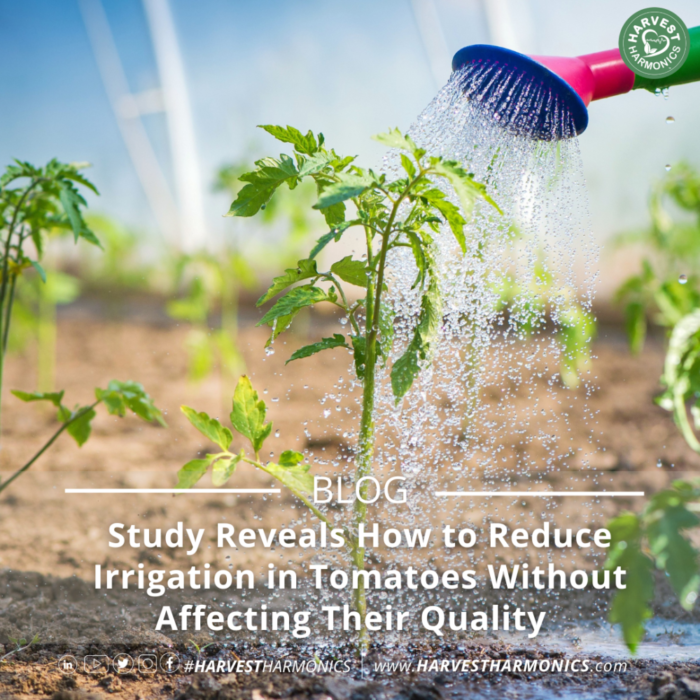
Study Reveals How to Reduce Irrigation in Tomatoes Without Affecting Their Quality
Study evaluated the effect of a sustainable agricultural practice, deficit irrigation in ‘Sunchocola’ tomatoes and found that the least amount of water does not affect the quality of the product Universidad de Sevilla
A study carried out by researchers from the University of Seville (2022) shows that deficit irrigation did not cause significant changes in the commercial quality of tomatoes (color, size, weight, firmness, sugars) while, at the same time, the content of healthy compounds like carotenoids tripled.
As revealed by the Mundo Agropecuario portal (2022), this study evaluated the effect of a sustainable agricultural practice, deficit irrigation on ‘Sunchocola’ tomatoes, characterized by their intense reddish-green coloration.
Deficit irrigation consists of reducing the use of water trying not to affect production. In this sense, the study proposes to reduce irrigation in the most resistant crop stage, controlling the level of stress in the plant, so as not to affect the quality and production of the tomato.
Specifically, the effect of this practice on productivity, commercial quality and the content of healthy compounds (carotenoids and phenolic compounds) was studied. The results show that there were no significant changes in the commercial quality of the product.
Likewise, although the content of phenolic compounds decreased slightly, the presence of carotenoids tripled. This result is of great nutritional importance since the consumption of carotenoids is associated with a lower risk of various diseases in addition to cosmetic benefits.
Similarly, the article highlights that, taking into account that the tomato is one of the most important crops worldwide, the efficient transfer of these results and those of other similar studies could contribute significantly to the global saving of irrigation water and the production of tomatoes with a higher content of compounds that are of great importance for cosmetic and health reasons.
If your goal is to optimize the use of water to irrigate your crops, Kyminasi Plant Crop Booster technology will help you achieve it.
We will show you some of our fantastic water saving results in others crops:
Improved Drought Tolerance & 75% Yield Increase of Grapes
in Peru
Date: June, 2020 (Fall)
Place: Casma, Perú
Details: Kyminasi Plant Booster (KPB) technology was installed on 5 hectares of Red Globe grapes at Frutos Hergu’s Farm in Peru.
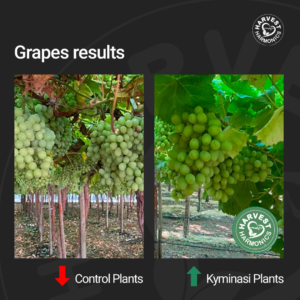
Results: Drought conditions in 2020 caused a 30% water deficit that adversely impacted yields in the Casma region of Peru where this farm is located. The field that was treated with KPB achieved greater yields and produced 75% more grapes than the control field even during an extreme drought. Overall, the KPB field produced 52.5% more grapes than the previous year’s yield.
KPB Grape Yield: 42 metric tons
Control Grape Yield: 24 metric tons
46% Reduction in Water Usage & 30% Yield Increase of Walnuts
in Chile
Date: January, 2021 (Summer)
Place: Chile
Details: Kyminasi Plant Booster (KPB) technology was installed on a field of walnut trees that had experienced salt toxicity as a result of a water deficit from the previous 3 years.
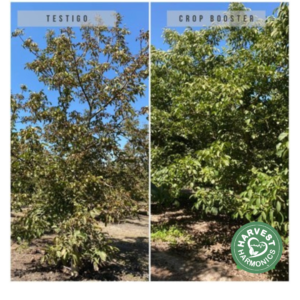
Results: The salt toxicity condition of the walnut trees was able to be completely reversed with the KPB technology and this allowed a total recovery of the vigor of the plants. KPB helped to decompact the soil and this allowed for a 46% reduction in water usage. The KPB walnut trees produced 30% more yield as compared to the control field.
Source:
University of Seville (March 7th, 2022). “Tomates de igual calidad con menos agua de riego”. Mundo Agropecuario. https://mundoagropecuario.com/tomates-de-igual-calidad-con-menos-agua-de-riego/
Press Room

Agricultural Technology for Farmers in India
Harvest HarmonicsTM New Biophysics Agricultural Technology For Farmers In India The Agricultural Biophysics technology, 20…
1

Organic Earth Tech, OETI, Launches One Million Dollar Technology
After hurricanes Maria and Irma, Puertorrican farmers are yet to receive the needed aid to recover. Organic Earth Tech…
0

Produce More From Less
CEO Harvest Harmonics Frank Arlia speaking at Replenish. Earth interview by Tia Kansara – London Climate Action Week. How…
0

Replenish Earth and the Environmental RE Talk Series
Replenish Earth and the environmental RE Talk Series event that reunited the top thinkers in the world Harvest Harmonics…
1
5 things you need to know about how Kyminasi Plant Crop Booster works
The Kyminasi Plant Crop Booster is a new technology that improves the health of plants, humans, and the environment overall. This technology can be installed on any irrigation system in the world.
Our devices consist of micro-transmitters that have been programmed with the specific bio-physical frequencies that a plant and its environment need for optimal operation and maximum biological potential.
Kyminasi Plant Crop Booster Technology works like a computer microchip. Precise “software-like” instructions are transmitted to plants using waves at different frequencies.
As the transmitted frequencies correspond to the natural molecular frequencies of soils and plants, these instructions can be received from them and will change function accordingly.
Kyminasi Plant Crop Booster Technology signals enhance and help balance secondary and micronutrient absorption and utilization.
Because this is a revolutionary technology that is transforming farming operations on five continents, there are many aspects that set it apart from other options on the market. For example:
- It lasts for two years: Kyminasi Plant Crop Booster Technology devices are designed to be installed at the irrigation system of any farm and their positive effects last for two years after water starts to pass throw the pipe.
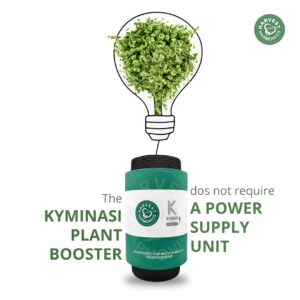
2. It doesn’t need a power supply: Kyminasi Plant Crop Booster Technology is completely self-powered. It doesn’t require maintenance or power, so literally you just have to attach it to the outside of the pipe without any expensive equipment or any power sources beyond the transmitters themselves.
3. It’s compatible with organic growth: Kyminasi Plant Crop Booster Technology is organic friendly because we’re using a signaling system and not a chemical input.
There’s really nothing in this technology which would violate any organic certifications, but in cases where organic growers are worried about it, we would consult with the certifier that you have.

4. It doesn’t harm pollinators: Kyminasi Plant Crop Booster Technology is completely safe for pollinators, in fact, this product is not a pesticide.
It doesn’t kill insects, but it stimulates the natural biological processes of plants in such a way that their own biological defense mechanisms against harmful insects are enhanced, however, it’s not going to harm insects because we’re not using a chemical approach.
We haven’t noticed any negative effects on any of our installations. We have over 500 farms around the world using the technology and we don’t have single report of any kind of pollinator problems.
5. It works on any type of irrigation: Kyminasi Plant Crop Booster Technology will work with flood irrigation, drip irrigation or pivots. This technology can be adapted to any type of irrigation system. Also, we are working on a foliar application for farmers that do not irrigate, that is still in the R&D phase.
Kyminasi Plant Crop Booster Technology is a systemic solution for plants to stay producing and they keep the photosynthesis process going no matter what’s happening and because of that we’re seeing increases in yield and quality in farms all over the world.
Press Room
Agricultural Technology for Farmers in India
Harvest HarmonicsTM New Biophysics Agricultural Technology For Farmers In India The Agricultural Biophysics technology, 20…
1
Organic Earth Tech, OETI, Launches One Million Dollar Technology
After hurricanes Maria and Irma, Puertorrican farmers are yet to receive the needed aid to recover. Organic Earth Tech…
0
Produce More From Less
CEO Harvest Harmonics Frank Arlia speaking at Replenish. Earth interview by Tia Kansara – London Climate Action Week. How…
0
Replenish Earth and the Environmental RE Talk Series
Replenish Earth and the environmental RE Talk Series event that reunited the top thinkers in the world Harvest Harmonics…
1
Universitiy Result
As Harvest Harmonics is a new technology that is completely revolutionizing the way we do agriculture, many scientists have become interested in the completely new understanding of exactly how plants work and how we can make them perform their functions at their highest level all the time with this organic and sustainable solution.
Harvest Harmonics is on a mission to revitalize and revolutionize the agriculture industry with new technology that increases nutrient absorption, yield, and reduces the use of chemicals and pesticides in all farming operations. The result is greater profit for the hard work of our farmers and better quality of fruits and vegetables so that everyone can eat.
The basis of this technology starts from the principle of biophysics, we apply physics directly to the biology of plants. All living things on this planet have a kind of biology and plants are no different. In fact, plants operate according to a specific pattern of signals that allow them to produce all the fruits and vegetables we enjoy eating. We studied about thousands of varieties of plants and discovered that in all types of plants: grass, grass, fruit trees, no matter what it is, all those that perform the process of photosynthesis operate with a set of ordered signals that allows them to produce fruits and vegetables. And we noticed that stressed plants of the same variety have an altered signal pattern and, as a result, are not able to produce the energy they need to grow, be healthy, and generate fruits and vegetables. And we can mention that using biophysical equipment there is a positive change in this pattern of signals.
So what we do is reinforce the metabolism of the plant using a set of frequencies that allows the plant to grow resistant, healthy and fast, operating according to its optimal potential. This technology has never been seen, they are not magnets or magnets, it is a completely new technology. What we do is program our microtransmitters with these 3000 healthy photosynthesis signals and install it in the irrigation system, so that every moment the farmer waters his plants is essentially reinforcing the ideal metabolism of that plant and that plant will be able to produce more energy for longer periods of time, which previously could not have been possible. In fact, it has been studied that most plants cannot absorb and use all the amount of fertilizer, for example, that we give to plants, on average they use 20 to 30% in a good field. Our technology helps to increase to a probable value of 40-50% allowing them to use the nutrition we give you. In fact, in many cases, we found that we were able to completely eliminate the use of fertilizers because the plants absorb what they need and produce good crops without needing to add an extra amount of fertilizer. And improving microbial activity in the soil is also helping to produce the nitrogen that plants need to survive and grow healthy.
That is why today, in this blog, we want to share one of our results with universities that participate in our program of 1000 scientific trials around the world with Kyminasi Plant Crop Booster technology. If you are interested in doing a scientific essay at a University with our technology, please contact us.
Thesis in Corn: Universidad Francisco de Paula Santander
Date: March 2022.
Place: Ocaña, Colombia.
Details: Kyminasi Plant Booster was installed at Universidad Francisco de Paula Santander, Colombia.
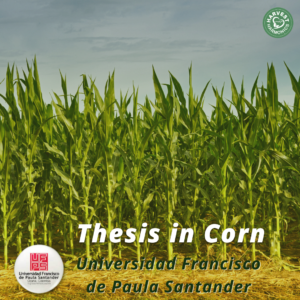
Some Results: The pH of the soil was stabilized from slightly acidic to neutral and the EC of the soil solution was reduced by 50% in the treatment field, while in the control field the acidity of the soil increased and the EC remained the same.
- The average height in the treatment field was 2.80m and in the control field 1m.
- The stem thickness in the control field was 1.78cm and in the treatment it was 2.76cm.
- In average width of the blade was 9.08cm in the treatment and in the control it was 6.89cm
- The average number of leaves in the treatment was 11.64 and in the control was 9.16
- The Green Forage Yield (RFV) in the treatment was 125 while the RFV in the control was 115.
- The linear yield of maize in the treatment was 7.59kg/m and in the control it was 1.58kg/m.
- The raw fodder obtained in the treatment field was 79,664kg and in the control field it was 11,672kg.
- Water consumption in the treatment field was 94,770L and in the control it was 189,540L.
- Brix degrees in the treatment were 11.5% and in the control 8.5%.
- Titratable acidity (probability of rot) is lower in treatment with 2.5% and the control has on average 3.75%.
- The average maturity index in the treatment is 4.6 (post-harvest durability) and the control is 2.3.
- The beneficial microbiota in the treatment field is 7.92% higher than in the control with 4.47%.
- Final average of cobs per plant was 2 in the treatment and 1 in the control.
Created By: Mariangel Rodriguez
Press Room
Agricultural Technology for Farmers in India
Harvest HarmonicsTM New Biophysics Agricultural Technology For Farmers In India The Agricultural Biophysics technology, 20…
1
Organic Earth Tech, OETI, Launches One Million Dollar Technology
After hurricanes Maria and Irma, Puertorrican farmers are yet to receive the needed aid to recover. Organic Earth Tech…
0
Produce More From Less
CEO Harvest Harmonics Frank Arlia speaking at Replenish. Earth interview by Tia Kansara – London Climate Action Week. How…
0
Replenish Earth and the Environmental RE Talk Series
Replenish Earth and the environmental RE Talk Series event that reunited the top thinkers in the world Harvest Harmonics…
1
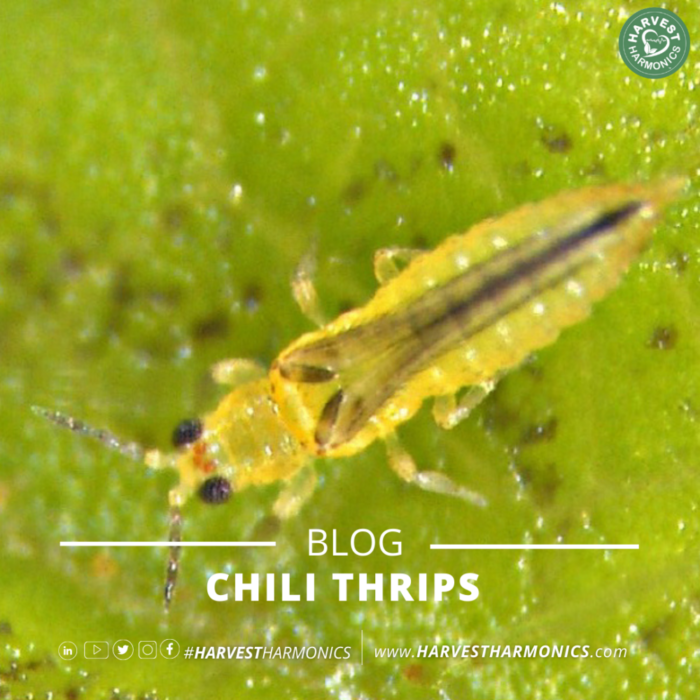
Chili Thrips
Scirtothrips dorsalis or also known as Chilli thrips is a harmful organism listed as a quarantine pest. It is an insect with a wide spectrum of host plants (more than 150 species), including crops of commercial interest such as: beans, tomato, eggplant, cucumber, onion, pepper, peanut, soybean, strawberry, corn, citrus, cocoa, banana, fig, grape, kiwi, mango, peach, rose, pear, chrysanthemum, tea, cotton, tobacco, etc. Likewise, it can be found in numerous ornamental or spontaneous species (Plant Health Service Murcia, 2017).
It is an extremely voracious invasive pest, widely distributed worldwide, first described in India in 1919. Currently, its distribution is mainly located in Southeast Asia, China, Japan, the Middle East, Oceania, Africa, the Caribbean and some countries. South America and, in more detail, in the United States (Florida, Texas, Georgia and Hawaii), Israel, New Guinea, South Africa and Uganda (Plant Health Service Murcia, 2017)
Its small size (2mm) and its rapid movement make it difficult to detect this insect in fresh vegetation. Eggs of up to 0.2 mm are inserted into the soft tissues of the plant, so these characteristics increase the chances of spreading Scirtothrips dorsalis through fresh plant materials (Agricola et al., n.d.)
This insect, with its mouthparts, extracts the contents of the epidermal cells, generating necrosis of the tissue, which changes the color turning it brown or black. It causes scars where it fed, distortion of the leaves, discoloration of the buds, as well as of the flowers and young fruits. It has not been recorded that it has feeding habits on mature tissues. Infested plants are stunted, and in severe cases total defoliation can occur, generating great losses. In addition, it is a transmitter of viruses that affect crops such as tobacco, peppers, peanuts and melons. S. dorsalis is a free-living organism that spreads to other locations through the flow of infested plant material (young leaves, apical parts of plants, flowers and fruits), as well as by air currents (Agricola et al., n.d.).
Apart from the direct damage, another of the problems that this pest can cause to some important crops is the fact that, by having to carry out specific chemical treatments for its control during the flowering-fruiting season, they can negatively affect numerous species of fauna. auxiliary that in turn keeps other pests of these crops controlled, causing their subsequent emergence (Rodríguez Tapia et al., 2016).
Due to the speed of its spread and the difficulty of detecting it, strategies for its control have been developed over the years, such as:
a) Biological fight: for the control of this plague, the literature shows the existence of several species that can exert a certain interaction with S. dorsalis, such as, for example; Orius spp. or Amblyseius swirskii, so it is to be assumed that in this case something similar will happen with some of the auxiliary species that already control other species of thrips that inhabit various orchards.
b) Technological fight: The placement of yellow gummed chronotropic plates has been shown to be a useful tool for their capture. In principle, this system could be suitable for use in population monitoring or mass capture (in the case of greenhouse crops). Another technology that would significantly help control it is Kyminasi Plant Crop Booster, which has been shown to significantly optimize the immune system of plants, so the incidence of plants is lower.
c) Chemical fight: The most suitable moment for its control is in the initial larval stage. The products that have been most effective in other countries where this pest is present would be pyrethroids, although there may be other active substances of interest such as imidacloprid, azadirachtin, spinosad or spirotetramat. However, the affected crop must be studied to determine, according to authorizations, which products would be used in each case (Plant Health Service Murcia, 2017).
Sources:
129620-SERVICIO DE SANIDAD VEGETAL MURCIA_FICHA SCIRTOTHRIPS DORSALIS_Enero 2017. (n.d.).
Agrícola, P., Servicio, G., & Vegetal, S. (n.d.). Scirtothrips dorsalis CONSEJERÍA DE AGRICULTURA, PESCA Y DESARROLLO RURAL INTRODUCCIÓN PRINCIPALES HUÉSPEDES, DESCRIPCIÓN Y CICLO BIOLÓGICO.
Rodríguez Tapia, J. L., Hernández Espinosa, D., Zamora Rodríguez, V., Pérez Castro, J. M., & Fortes Ponce, H. (2016). Primer informe de la presencia de Scirtothrips dorsalis Hood (Thysanoptera: Thripidae) en Cuba first report of the presence of Scirtothrips dorsalis Hood (Thysa-noptera: Thripidae) in Cuba. In Hoddel & Mound (Vol. 20, Issue 1).
Press Room
Agricultural Technology for Farmers in India
Harvest HarmonicsTM New Biophysics Agricultural Technology For Farmers In India The Agricultural Biophysics technology, 20…
1
Organic Earth Tech, OETI, Launches One Million Dollar Technology
After hurricanes Maria and Irma, Puertorrican farmers are yet to receive the needed aid to recover. Organic Earth Tech…
0
Produce More From Less
CEO Harvest Harmonics Frank Arlia speaking at Replenish. Earth interview by Tia Kansara – London Climate Action Week. How…
0
Replenish Earth and the Environmental RE Talk Series
Replenish Earth and the environmental RE Talk Series event that reunited the top thinkers in the world Harvest Harmonics…
1