Setting Sustainability Goals

Setting sustainability goals is a crucial step towards achieving more sustainable farming practices.
After evaluating current farming practices, it is essential to determine what needs to be done to improve the sustainability of the farm.
The goals that are set should align with the specific needs of the farm and consider the environmental impact of farming practices.
Here are some steps to set sustainability goals for your farm:
1. Identify key areas for improvement:
The first step towards setting sustainability goals is to identify the areas that need improvement on the farm. This could include reducing chemical inputs, conserving water, improving soil health, or reducing greenhouse gas emissions. It is important to conduct a thorough evaluation of current farming practices to determine where improvements can be made.
2. Prioritize goals:
Once the key areas for improvement have been identified, it is essential to prioritize the goals based on their impact on the environment and the farm’s economic viability. It is important to focus on the goals that will have the most significant impact on sustainability and the farm’s bottom line.
3. Set specific and measurable goals:
Setting specific and measurable goals is critical to track progress and evaluate success. For example, instead of setting a general goal to reduce pesticide use, set a specific target to reduce pesticide use by 50% over the next five years. This helps to provide a clear target and a timeframe for achieving it..
4. Determine a timeline:
Setting a timeline for achieving sustainability goals is essential to keep the goals on track and provide a sense of urgency for making changes. It is important to set realistic timelines that take into account the time and resources required to achieve the goals.
5. Involve stakeholders:
Involving all stakeholders in the goal-setting process is critical to ensure that everyone is on board with the sustainability goals and can work together towards achieving them. This includes employees, customers, and suppliers. By involving all stakeholders, everyone can contribute to the success of the sustainability goals.
6. Review and revise goals:
Regularly reviewing progress towards the sustainability goals and making adjustments as needed is crucial to ensure that the goals remain relevant and achievable over time. This helps to ensure that the goals are aligned with the needs of the farm and are achieving the desired results.
By setting sustainability goals, farmers can work towards improving the environmental impact of their farming practices. By reducing chemical inputs, conserving water, improving soil health,(all of which can be assisted by Crop Booster) and reducing greenhouse gas emissions, farmers can improve the long-term sustainability of their farms. Setting specific, measurable goals and involving all stakeholders in the process can help to ensure that sustainability goals are achieved.
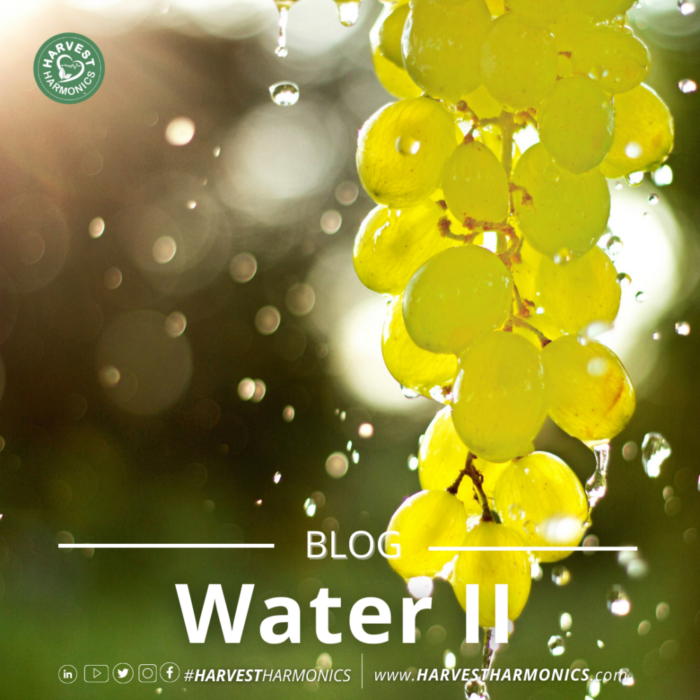
Water II
“There is nothing softer and weaker than water, and yet there is nothing better for attacking hard and strong things.”
The Chinese sage Lao Tzu
Lao Tzu in the “Tao-Te Ching” explained this paradox like this. “Water’s ability to wash, soothe and nourish contrast with its brute power.” This is exhibited by Niagara Falls, tsunamis and the Grand Canyon (carved over time by the Colorado River). In the mid-eighties, some friends who were teachers and executives from Delphi, Oregon school, invited my wife and I to make a 1o-day float trip in three huge rafts down the Colorado River. There were 10 of us. My son Tom was a student there at the time. When you see and feel the awesomeness of that 278 mile long, 10 miles across and one mile deep trench through solid rock in some places, you instantly get the idea of what water can do. Indeed, water, over the eons made that enormous ditch.
What Does This Have to Do With Kymnasi Plant Booster?
This series on water deals with the mystery of water, how scientists still don’t understand it fully, and how it is the perfect vehicle for making crops and their products amazing in every way possible. So here goes more about water, which is the perfect way to make harvests on the level of miraculous.
Some of the Implausible and Inexplicable Phenomena of Water.
Similarly paradoxical, water is both extremely familiar making up nearly two-thirds of our own bodies and covering three-quarters of the planet and extremely mysterious. Many of its properties will completely surprise you. Others are so unusual that they still defy scientific understanding.
Surface Tension

Sometimes water seems to defy the laws of physics. It holds together in spite of the attempts of gravity to control it. Surface tension of water can cause things to float which are denser than water, allowing organisms to literally walk on water . This is the power of surface tension, a characteristic that makes the outer or surface layer of a body of water act like a thin flexible plastic sheet or membrane. Yet the surface is just water. For example: Surface tension is what allows objects with a higher density than water such as a paper clip, razor blades and insects (e.g. water striders) to float on a water surface without becoming even partly submerged.
Slippery Slippiness
Theorists have speculated that it may be the very act of slipping, or skating making contact with the ice that melts the ice’s surface. Others think the fluid layer is there before the slipper or skater ever arrived, and, is somehow generated by the inherent motion of surface molecules. We know you’re looking for someone or something to blame, as you lie there on the ground fuming, but unfortunately the jury is still out on this one.
Solids Sink in Water. Ice is a Solid. Ice Floats. How is that again?
 Image from National Geographic
Iceberg in Greenland.
Although the solid form of almost every substance is denser than its liquid form, due to the fact that atoms in solids normally pack tightly together, this does not hold true for H2O. When water freezes, its volume increases by about 8 percent. This is the strange behavior that allows ice cubes, and even gargantuan icebergs, to float. Evidently that 8% increase in volume is air that makes ice float.
There Are So Many Unexplained Phenomena of Water

This is no technical manual to give you the explanations scientologists give for these enigmatic phenomena, but there are answers in the internet. Here are a few bafflements you can solve for yourself if you are of a mind to:
Why does hot water freeze faster than cold or cool water? No one know why.
- Above: an icy lake has no water on its surface but it is slippery as grease and you can bust your butt slipping down.
- On Earth, boiling water creates thousands of tiny vapor bubbles. In space, on the other hand, it produces one giant undulating bubble.
- When there’s a huge temperature gradient between water and the outside air say, when a pot of boiling water measuring 212 degrees Fahrenheit (100 C) is splashed into air measuring minus 30 F (-34 C) a surprising effect occur
- When a drop of water lands on a surface much hotter than its boiling point, it can skitter across the surface for much longer than you’d expect. The droplet thus survives for several seconds before boiling away.
- When there’s a huge temperature gradient between water and the outside air say, when a pot of boiling water measuring 212 degrees Fahrenheit (100 C) is splashed into air measuring minus 30 F (-34 C) a surprising effect occurs. The boiling water will instantly turn to snow and blow away.
- Why is each beautiful snowflake hexagonal in shape and exclusively different from any other?
- Where did all this water come from on planet earth, now covering 70% of earth’s surface?
Want Answers to These Questions?
Like I said, this is not a scientific treatise giving answers to all these wonderful enigmas. But stand by, and I will give some answers on Water III, the following blog. Some are not answered by science yet. Ain’t that special, the most abundant element on earth, and most important element to human survival, yet they have no answer.
But There is an Incredible Discovery – instead of three “types of water,” liquid, vapor and solid (ice), There is a Fourth.
Hang with me, I will tell you all about this in Water IV.
L D Sledge
The Writing Whisperer
Press Room

Agricultural Technology for Farmers in India
Harvest HarmonicsTM New Biophysics Agricultural Technology For Farmers In India The Agricultural Biophysics technology, 20…
1

Organic Earth Tech, OETI, Launches One Million Dollar Technology
After hurricanes Maria and Irma, Puertorrican farmers are yet to receive the needed aid to recover. Organic Earth Tech…
0

Produce More From Less
CEO Harvest Harmonics Frank Arlia speaking at Replenish. Earth interview by Tia Kansara – London Climate Action Week. How…
0
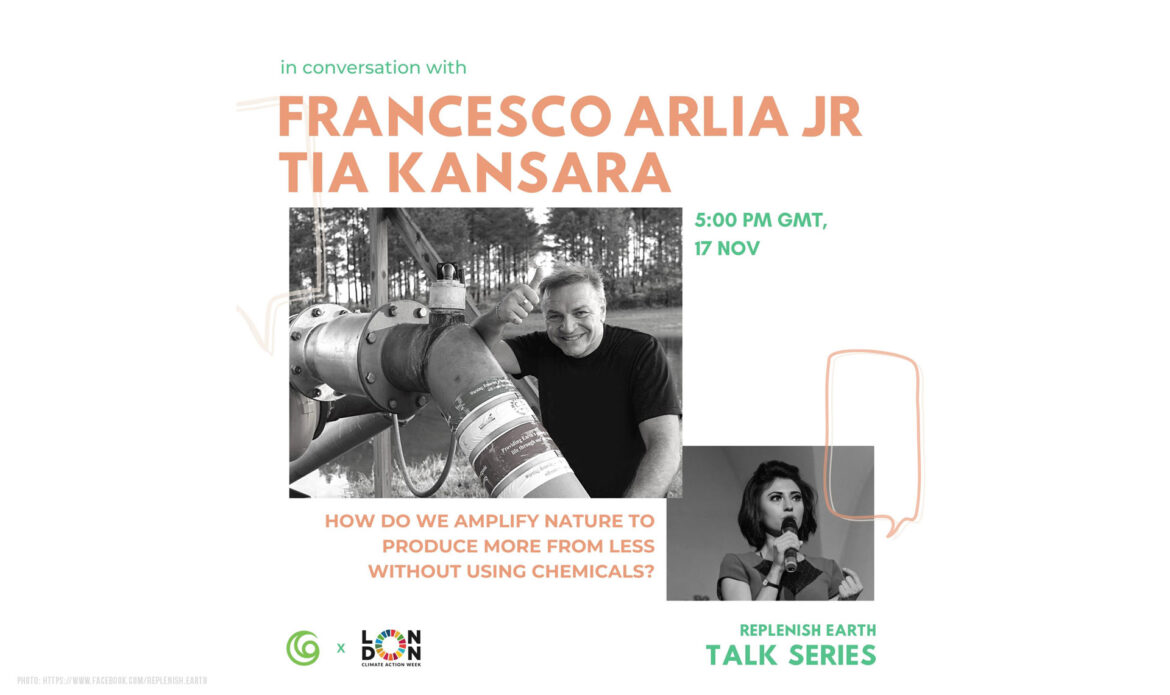
Replenish Earth and the Environmental RE Talk Series
Replenish Earth and the environmental RE Talk Series event that reunited the top thinkers in the world Harvest Harmonics…
1
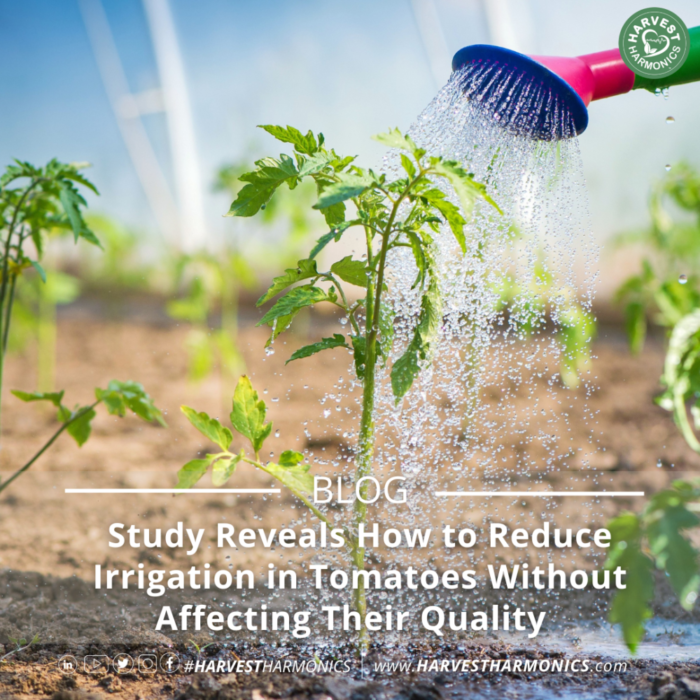
Study Reveals How to Reduce Irrigation in Tomatoes Without Affecting Their Quality
Study evaluated the effect of a sustainable agricultural practice, deficit irrigation in ‘Sunchocola’ tomatoes and found that the least amount of water does not affect the quality of the product Universidad de Sevilla
A study carried out by researchers from the University of Seville (2022) shows that deficit irrigation did not cause significant changes in the commercial quality of tomatoes (color, size, weight, firmness, sugars) while, at the same time, the content of healthy compounds like carotenoids tripled.
As revealed by the Mundo Agropecuario portal (2022), this study evaluated the effect of a sustainable agricultural practice, deficit irrigation on ‘Sunchocola’ tomatoes, characterized by their intense reddish-green coloration.
Deficit irrigation consists of reducing the use of water trying not to affect production. In this sense, the study proposes to reduce irrigation in the most resistant crop stage, controlling the level of stress in the plant, so as not to affect the quality and production of the tomato.
Specifically, the effect of this practice on productivity, commercial quality and the content of healthy compounds (carotenoids and phenolic compounds) was studied. The results show that there were no significant changes in the commercial quality of the product.
Likewise, although the content of phenolic compounds decreased slightly, the presence of carotenoids tripled. This result is of great nutritional importance since the consumption of carotenoids is associated with a lower risk of various diseases in addition to cosmetic benefits.
Similarly, the article highlights that, taking into account that the tomato is one of the most important crops worldwide, the efficient transfer of these results and those of other similar studies could contribute significantly to the global saving of irrigation water and the production of tomatoes with a higher content of compounds that are of great importance for cosmetic and health reasons.
If your goal is to optimize the use of water to irrigate your crops, Kyminasi Plant Crop Booster technology will help you achieve it.
We will show you some of our fantastic water saving results in others crops:
Improved Drought Tolerance & 75% Yield Increase of Grapes
in Peru
Date: June, 2020 (Fall)
Place: Casma, Perú
Details: Kyminasi Plant Booster (KPB) technology was installed on 5 hectares of Red Globe grapes at Frutos Hergu’s Farm in Peru.
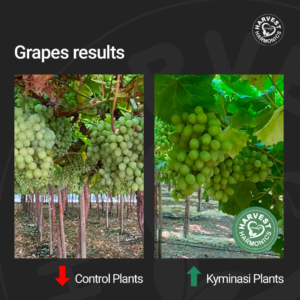
Results: Drought conditions in 2020 caused a 30% water deficit that adversely impacted yields in the Casma region of Peru where this farm is located. The field that was treated with KPB achieved greater yields and produced 75% more grapes than the control field even during an extreme drought. Overall, the KPB field produced 52.5% more grapes than the previous year’s yield.
KPB Grape Yield: 42 metric tons
Control Grape Yield: 24 metric tons
46% Reduction in Water Usage & 30% Yield Increase of Walnuts
in Chile
Date: January, 2021 (Summer)
Place: Chile
Details: Kyminasi Plant Booster (KPB) technology was installed on a field of walnut trees that had experienced salt toxicity as a result of a water deficit from the previous 3 years.
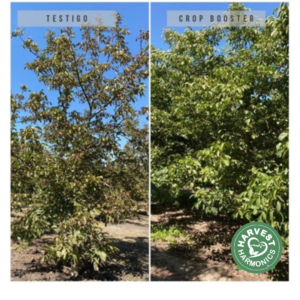
Results: The salt toxicity condition of the walnut trees was able to be completely reversed with the KPB technology and this allowed a total recovery of the vigor of the plants. KPB helped to decompact the soil and this allowed for a 46% reduction in water usage. The KPB walnut trees produced 30% more yield as compared to the control field.
Source:
University of Seville (March 7th, 2022). “Tomates de igual calidad con menos agua de riego”. Mundo Agropecuario. https://mundoagropecuario.com/tomates-de-igual-calidad-con-menos-agua-de-riego/
Press Room
Agricultural Technology for Farmers in India
Harvest HarmonicsTM New Biophysics Agricultural Technology For Farmers In India The Agricultural Biophysics technology, 20…
1
Organic Earth Tech, OETI, Launches One Million Dollar Technology
After hurricanes Maria and Irma, Puertorrican farmers are yet to receive the needed aid to recover. Organic Earth Tech…
0
Produce More From Less
CEO Harvest Harmonics Frank Arlia speaking at Replenish. Earth interview by Tia Kansara – London Climate Action Week. How…
0
Replenish Earth and the Environmental RE Talk Series
Replenish Earth and the environmental RE Talk Series event that reunited the top thinkers in the world Harvest Harmonics…
1
5 things you need to know about how Kyminasi Plant Crop Booster works
The Kyminasi Plant Crop Booster is a new technology that improves the health of plants, humans, and the environment overall. This technology can be installed on any irrigation system in the world.
Our devices consist of micro-transmitters that have been programmed with the specific bio-physical frequencies that a plant and its environment need for optimal operation and maximum biological potential.
Kyminasi Plant Crop Booster Technology works like a computer microchip. Precise “software-like” instructions are transmitted to plants using waves at different frequencies.
As the transmitted frequencies correspond to the natural molecular frequencies of soils and plants, these instructions can be received from them and will change function accordingly.
Kyminasi Plant Crop Booster Technology signals enhance and help balance secondary and micronutrient absorption and utilization.
Because this is a revolutionary technology that is transforming farming operations on five continents, there are many aspects that set it apart from other options on the market. For example:
- It lasts for two years: Kyminasi Plant Crop Booster Technology devices are designed to be installed at the irrigation system of any farm and their positive effects last for two years after water starts to pass throw the pipe.
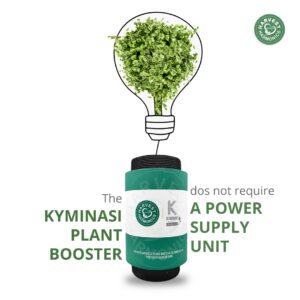
2. It doesn’t need a power supply: Kyminasi Plant Crop Booster Technology is completely self-powered. It doesn’t require maintenance or power, so literally you just have to attach it to the outside of the pipe without any expensive equipment or any power sources beyond the transmitters themselves.
3. It’s compatible with organic growth: Kyminasi Plant Crop Booster Technology is organic friendly because we’re using a signaling system and not a chemical input.
There’s really nothing in this technology which would violate any organic certifications, but in cases where organic growers are worried about it, we would consult with the certifier that you have.

4. It doesn’t harm pollinators: Kyminasi Plant Crop Booster Technology is completely safe for pollinators, in fact, this product is not a pesticide.
It doesn’t kill insects, but it stimulates the natural biological processes of plants in such a way that their own biological defense mechanisms against harmful insects are enhanced, however, it’s not going to harm insects because we’re not using a chemical approach.
We haven’t noticed any negative effects on any of our installations. We have over 500 farms around the world using the technology and we don’t have single report of any kind of pollinator problems.
5. It works on any type of irrigation: Kyminasi Plant Crop Booster Technology will work with flood irrigation, drip irrigation or pivots. This technology can be adapted to any type of irrigation system. Also, we are working on a foliar application for farmers that do not irrigate, that is still in the R&D phase.
Kyminasi Plant Crop Booster Technology is a systemic solution for plants to stay producing and they keep the photosynthesis process going no matter what’s happening and because of that we’re seeing increases in yield and quality in farms all over the world.
Press Room
Agricultural Technology for Farmers in India
Harvest HarmonicsTM New Biophysics Agricultural Technology For Farmers In India The Agricultural Biophysics technology, 20…
1
Organic Earth Tech, OETI, Launches One Million Dollar Technology
After hurricanes Maria and Irma, Puertorrican farmers are yet to receive the needed aid to recover. Organic Earth Tech…
0
Produce More From Less
CEO Harvest Harmonics Frank Arlia speaking at Replenish. Earth interview by Tia Kansara – London Climate Action Week. How…
0
Replenish Earth and the Environmental RE Talk Series
Replenish Earth and the environmental RE Talk Series event that reunited the top thinkers in the world Harvest Harmonics…
1

Some Catalysts in Modern Agriculture
Human beings, in their eagerness to improve crops, do research with the purpose of improving what nature already does.
In the agriculture business, there is always the expectation of improving crop production in order to yield more and better food.
A metabolic catalyst is a substance or technology in the acceleration of chemical, physiological or metabolic processes to achieve better and faster results.
A catalyst is a substance, impulse or action that, by participating in a chemical or physical reaction, is capable of increasing the reaction rate without being consumed in the process. Catalysts speed up reactions by lowering the activation energy or by changing the mechanism of the activation. Catalysts can be physical (abiotic), organic (biotic) or mineral that can act independently.
Abiotic catalysts are those that have a physical action on microorganisms that act in the soil, participating in the mineralization processes of organic substances that keep nutrients immobilized and that require this help to release them and put them in the solution of the soil so that they are absorbed by the roots of the plant together with the water. These catalysts can be created simply by electric, magnetic or acoustic waves, which can be activated and energized by the excitation of the electrons of the atoms that are a constitutive part of soil microorganisms. When energized, they take less time to fulfill their function of mineralizing humic and fulvic substances: main components of organic matter.
Among the waves that can help in the development of plants, animals and humans, are the acoustic, which have unique properties in the creation of energy at the atomic level. From a photon, when it collides with the electrons of the components of living cells, it causes an uncontrollable alteration that, by acting inside the cells, can be transformed into other types of energies, which help in the acceleration of metabolism of living beings and, in the case of plants, photosynthesis and osmosis.
Some theses have been presented that point to the beneficial qualities of acoustic waves, such as music, with medicinal qualities on the human being, for example, reducing stress and strengthening the immune system.
The notion that the health of humans and animals can be fine-tuned through sound emphasizes the “frequency” nature of bodies, that is, the quality that is receptive to vibrations emitted by external forces, in this case, acoustic waves. The hypothesis that sound can harmonize the physical body and thus combat specific ailments or provide specific benefits has led to the fact that, at present, many therapies have been designed using sound waves. Certain radio frequencies have even been identified that directly influence different aspects of living beings.
There is talk of frequencies that encourage the cells to be healthy, others that cause stability in the circulation of chlorophyll, some that promote DNA regeneration and others that cause cells to be cleansed of toxic substances; many other benefits can be found.
On the other hand, an experiment was given to demonstrate the effect of electric waves on the behavior of plants. It was carried out in a rose greenhouse, which presented plants with a high state of stress, despite the fact that the soil analysis showed a good degree of fertility.
These electrical impulses were applied, after pruning, to the plants that presented an appearance of physiological dryness. Despite the fact that the soil contained water at the field capacity level, the treated rose plants showed a very good response to the treatment and it was very interesting to observe that they came out of their bad condition in a fairly reasonable period.
The conclusion reached with this experimental study, after several laboratory tests, was that the impulses emitted by this device acted as physical catalysts, producing an acceleration of the electrons of the atoms of plant cells, the same that produced an acceleration in the photosynthetic process and therefore in the general metabolism of the plant, taking it out of the lethargy in which they were.
By Arantza Castro
Press Room
Agricultural Technology for Farmers in India
Harvest HarmonicsTM New Biophysics Agricultural Technology For Farmers In India The Agricultural Biophysics technology, 20…
1
Organic Earth Tech, OETI, Launches One Million Dollar Technology
After hurricanes Maria and Irma, Puertorrican farmers are yet to receive the needed aid to recover. Organic Earth Tech…
0
Produce More From Less
CEO Harvest Harmonics Frank Arlia speaking at Replenish. Earth interview by Tia Kansara – London Climate Action Week. How…
0
Replenish Earth and the Environmental RE Talk Series
Replenish Earth and the environmental RE Talk Series event that reunited the top thinkers in the world Harvest Harmonics…
1