


Who is Mainly Responsible for Greenhouse Gas Emissions?
Where and from which sectors does the greatest amount of Greenhouse Gases, a key factor in Climate Change, originate? Report by Eng. Gustavo Oliverio of the Producir Conservando Foundation.
It is surprising to see how the issue of greenhouse gas (GHG) emissions linked to climate change and a direct connection with livestock activities, meat or dairy production is raised on a recurring basis.
There are numerous sources of information on the participation of those responsible for emissions, both where they originate (countries or regions) and the different sectors that cause them. It clearly emerges from them that between 78-85% of GHG emissions are produced in China, the rest of Asia, the EU, the USA and India. There is also agreement that, globally, sectors related to energy and the use of fossil fuels are responsible for 72-75%. In addition, 15-18% of total emissions are attributed to agriculture, forestry and land use, and the latest Food and Agriculture Organization Corporate Statistical Database (FAOSTAT) data indicates 12-13% of emissions as being of agricultural origin.
Livestock activities represent, according to these sources, between 4 and 5%.
What is not clarified in almost any of the sources is that the agricultural sector fixes or sequesters carbon (CO2) through photosynthesis carried out by crops, pastures and forestry and with this it obtains a Carbon Balance that, in the case of Argentina, for example, works carried out by Eng. E. Viglizzo show a positive Carbon Balance, that is, the fixation or sequestration of CO2 is greater than the emissions that are produced.
“It is remarkable to see in many cases a tremendous vision of the environmental issue that leads to extreme positions where everything is mixed and confused.” Eng. Gustavo Oliverio.
It is clear that we must work hard to reduce emissions and increase CO2 sequestration in all sectors and implement the necessary practices to obtain a positive Carbon Balance, but it is necessary to differentiate the ill-intentioned indications about agricultural activities and livestock that are responsible for causing climate change for strategic and commercial reasons of activities that compete in the food market.
Dr. Jason Clay (WWF) raised a few years ago the need to make changes in production systems to achieve global food security for 10 billion inhabitants in 2050 and be Sustainable. Sustainable intensification and greater efficiency in all production processes will be the key to achieving this.
Source: World Recourses Institute 2020
By Arantza Castro
Press Room

Agricultural Technology for Farmers in India
Harvest HarmonicsTM New Biophysics Agricultural Technology For Farmers In India The Agricultural Biophysics technology, 20…
1

Organic Earth Tech, OETI, Launches One Million Dollar Technology
After hurricanes Maria and Irma, Puertorrican farmers are yet to receive the needed aid to recover. Organic Earth Tech…
0

Produce More From Less
CEO Harvest Harmonics Frank Arlia speaking at Replenish. Earth interview by Tia Kansara – London Climate Action Week. How…
0

Replenish Earth and the Environmental RE Talk Series
Replenish Earth and the environmental RE Talk Series event that reunited the top thinkers in the world Harvest Harmonics…
1

The Importance of Amino Acids in Agriculture
It is an evidence that biostimulants for plants are on the rise and have come to the agricultural sector to stay, since this class of products has many benefits to contribute to agriculture and, in addition, they are respectful with the environment. In today’s post, we are going to specify the types of biostimulants in agriculture and we are going to explain each of them in detail.
Biostimulants are divided into three big groups: amino acids, algae extract and humid and fulvic acids.
Amino acids are widely used in agriculture due to their numerous benefits, acting on various aspects such as resistance to stress, photosynthesis, pollination, the activation of phytohormones and other growth substances, the balance of flora in soils and the system of absorption and translocation of microelements at the plant level.
Amino acids in agriculture are the fundamental components of proteins. Each protein has a specific sequence of amino acids in which each of them has a defined position. When the protein is formed, the plant needs the amino acids determined from its sequence and they only fit correctly in the chain of those specific amino acids in the L form and in the position and order established.
There are a total of 20 proteogenic amino acids, which can be L-amino acids or D-amino acids. Only, L-amino acids have biological functions and each of them is involved in different metabolic processes in plants, protein formation.
There are several ways to obtain amino acids, by enzymatic hydrolysis, chemical hydrolysis and also by chemical synthesis. Of course, the amount and type of amino acid in one protein or another varies.
The importance of the production process is fundamental since depending on the one used, one or the other structures will be obtained, that is, the enzymatic hydrolysis will obtain L-amino acids (stereoselective) and the acid hydrolysis will obtain L and D amino acids at 50% (racemic).
We cannot forget that the origin of the raw material is also very important in the first place since depending on it we will obtain more or less amino acids of one type or another. We must include that there are also other organic compounds other than the amino acids that are obtained, which will more or less favor biostimulation.
The origins of the amino acids are chemical, animal or vegetable that as such individual amino acids are the same, but there are other quality factors that influence, chemical residues, other compounds that are in the raw material to obtain the amino acids, different types of regulations depending on provenance.
The mechanisms and modes of action of the products will come from the combination of amino acids together with other compounds producing a function and bioactivity in crops.
At what point do we apply amino acids to plants?
The ideal time to apply them is when the plants are in a period of growth, flowering and fruiting or during unfavorable external conditions.
All the products are with enzymatic L-amino acids of plant origin, they contribute to an efficient and sustainable fertilization since with this type of biostimulation we are collaborating with the conservation of the environment because better agronomic yields are achieved and therefore less CO2 per Kg / Plant.
Saving energy after the application of amino acids will be very useful, especially during critical periods such as the lifting of vegetative rest, the stages of flower formation, the differentiation of the shoots, the setting, the ripening of the fruits. and when the plant suffers stress due to external or meteorological factors.
By Arantza Castro
Press Room
Agricultural Technology for Farmers in India
Harvest HarmonicsTM New Biophysics Agricultural Technology For Farmers In India The Agricultural Biophysics technology, 20…
1
Organic Earth Tech, OETI, Launches One Million Dollar Technology
After hurricanes Maria and Irma, Puertorrican farmers are yet to receive the needed aid to recover. Organic Earth Tech…
0
Produce More From Less
CEO Harvest Harmonics Frank Arlia speaking at Replenish. Earth interview by Tia Kansara – London Climate Action Week. How…
0
Replenish Earth and the Environmental RE Talk Series
Replenish Earth and the environmental RE Talk Series event that reunited the top thinkers in the world Harvest Harmonics…
1
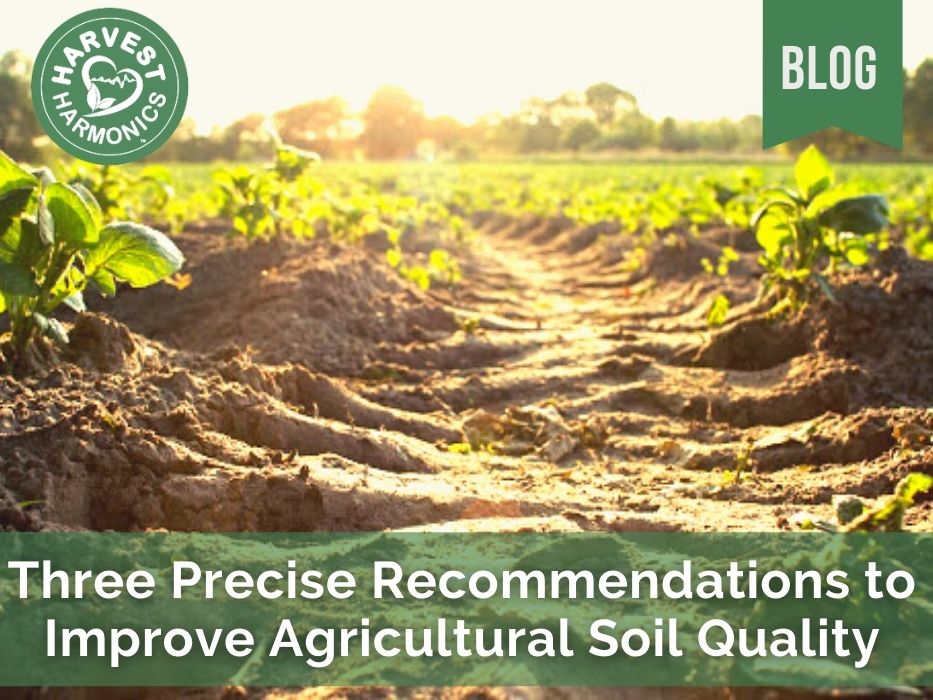
Three Precise Recommendations to Improve Agricultural Soil Quality
Soils are the source of food, which sustains life on Earth. As we can see, they play a very important role in global agricultural production. For this reason, every year efforts are made to improve its quality; because a healthy soil is the crucial ally of optimal productions.
Farmland must:
1. Possess all the nutrients necessary for plant growth.
2. Provide support to keep them firm during their development.
3. Ensure enough air and water for the roots.
4. Have good drainage to avoid excess fluid.
As the cultivation capacity will depend on the quality of the agricultural land, we want to share with you ways to improve it on your farm.
If each farmer regenerates his soils, he contributes in turn to a global improvement and to guarantee the availability of food for all.
Ways to improve soil quality on your farm:
1. Add compost to the soil
Compost is an organic fertilizer that releases nutrients to the soil slowly. This constant release nourishes it and improves its quality. The advantage of compost is that to prepare it you can use a wide variety of recycled organic waste, for which you do not have to invest money.
Tip:
Beware of organic waste of animal origin. Dog or cat droppings can introduce parasites and infections to your compost. Avoid them! Better mix dry leaves, branches, pieces of wood, shredded newspaper, vegetable residues or herbs.
Organic compost waste you can use:
· Fruits
· Vegetables
· Eggshells
· Rice and noodles
· Grass remains
· Oil and vinegar
2. Use cover plants
Some plants provide food, others provide shade; however, cover plants do both. They cover, protect and feed the soil to prepare it for future harvests. Using them is an excellent way to improve the quality of agricultural soil.
The first thing you have to do is identify the land on your farm that is deteriorated and needs care. Plant these plants to increase fertility. Its roots will open the earth channels through which water and oxygen will enter the surface. It is beneficial to plant plants from different families to increase the effectiveness of this process.
Tip:
Divide your harvest space in two, one for food production and the other to work with the increase in soil fertility. After a year, swap the spaces, so that the soil that was used for cultivation can be restored.
3. Incorporate plants with deep roots
One of the most influential scientists in history, Charles Darwin, once wrote:
“The roots are like the brains of plants; they feel the environment, they perceive the water and where there are more nutrients and they look for these resources. The roots are the smartest part of the plant.
The deeper these “brains” go, the easier it is for them to reach nutrients underground and transport them out. Planting deep-rooted plants is an efficient way to supply nutrients without investing in fertilizers.
Tip:
Every plant on your farm is a vitamin for your soil. When you clean or prune your land, you are extracting vitamins from it. Sow them again or use them as compost to increase fertility. You need to extract as much minerals to the surface to improve the quality of the agricultural land. Only your plants can do it with their roots.
By Arantza Castro
Press Room
Agricultural Technology for Farmers in India
Harvest HarmonicsTM New Biophysics Agricultural Technology For Farmers In India The Agricultural Biophysics technology, 20…
1
Organic Earth Tech, OETI, Launches One Million Dollar Technology
After hurricanes Maria and Irma, Puertorrican farmers are yet to receive the needed aid to recover. Organic Earth Tech…
0
Produce More From Less
CEO Harvest Harmonics Frank Arlia speaking at Replenish. Earth interview by Tia Kansara – London Climate Action Week. How…
0
Replenish Earth and the Environmental RE Talk Series
Replenish Earth and the environmental RE Talk Series event that reunited the top thinkers in the world Harvest Harmonics…
1