
What is Spray Drift?
What is Drift?
Spray drift is a term used throughout the industry to describe the physical movement of pesticide droplets or particles through the air away from the planned target area. The droplets most likely to drift are those less than 150 microns in diameter.
The most determining factor is the wind speed
The greater the distance between the spray tip of the nozzle and the target area, the greater the impact of wind speed on droplet movement.
An increase in operating speeds can cause the wind to return in the form of vortex-type overhead currents behind the sprayer, trapping small droplets and thus contributing to drift.
When temperatures are above 25ºC and relative humidity is low, small droplets are more likely to drift, due to the effects of evaporation.
Low dosages generally require the use of small nozzles, which increases the risk of loss.
The smaller the nozzle size and the higher the spray pressure, the smaller the droplet size and the greater the proportion of droplets likely to drift.
Useful tips to control drift
Reduce the working pressure to increase the size of the drops. Due to the decrease in flow rate, it may be necessary to use larger nozzles to stay within the dosage indicated on the product label.
Use nozzles that produce larger droplets, such as low drift nozzles or higher capacity nozzles.
Decrease boom height to reduce losses, while maintaining adequate overlap to ensure desired spray coverage.
Causes of spray drift
A number of variables contribute to spray droplet losses; these are mainly due to the spray equipment system and weather factors.
Drop size
Within the spray equipment system, droplet size is the most influential factor. When a liquid solution is sprayed under pressure, it atomizes into droplets of various sizes: The smaller the nozzle size and the higher the spray pressure, the smaller the droplets and thus the greater the proportion of droplets with a tendency to drift.
Spray height
As the distance between the nozzle and the target increases, the greater the impact that wind speed can have. The influence of the wind can increase the proportion of smaller droplets deflected from the target and considered as lost.
Working speed
Increased operating speeds can cause spray to drift into updrafts and vortices behind the sprayer, which traps fine droplets and can contribute to drift. Ideally, apply chemicals according to good professional practice at maximum working speeds of 6 to 8 km/h (with air induction nozzles – up to 10 km/h). As wind speeds increase, reduce working speed.
Wind speed
Among the meteorological factors that affect drift, the one with the greatest impact is wind speed. Increasing wind speed increases drift. Therefore, it is important to carry out spraying operations during relatively calm hours of the day. Generally, early morning and late afternoon are the quietest hours.
Some recommendations when spraying
In low wind speed situations, spraying can be done at recommended nozzle pressures.
As wind speeds increase to 3 m/s, spray pressure will need to be reduced and nozzle size increased to obtain larger droplets that are less prone to drift. Wind measurements should be taken during the spraying operation using an anemometer or wind gauge. As the risk of drift increases, it is very important to choose spray tips with coarser droplets that are less prone to drift.
When wind speeds exceed 5 m/s, spraying should be stopped.
Environmental temperature and humidity
At ambient temperatures above 25°C with low relative humidity, small droplets are especially prone to drift due to the effects of evaporation.
If you would like to know more about our technology, contact us on our website www.harvestharmonics.com
Source: https://www.unicoop.com.py/
Press Room
Agricultural Technology for Farmers in India
Harvest HarmonicsTM New Biophysics Agricultural Technology For Farmers In India The Agricultural Biophysics technology, 20…
1

Organic Earth Tech, OETI, Launches One Million Dollar Technology
After hurricanes Maria and Irma, Puertorrican farmers are yet to receive the needed aid to recover. Organic Earth Tech…
0

Produce More From Less
CEO Harvest Harmonics Frank Arlia speaking at Replenish. Earth interview by Tia Kansara – London Climate Action Week. How…
0

Replenish Earth and the Environmental RE Talk Series
Replenish Earth and the environmental RE Talk Series event that reunited the top thinkers in the world Harvest Harmonics…
1
Artificial Intelligence in Agriculture
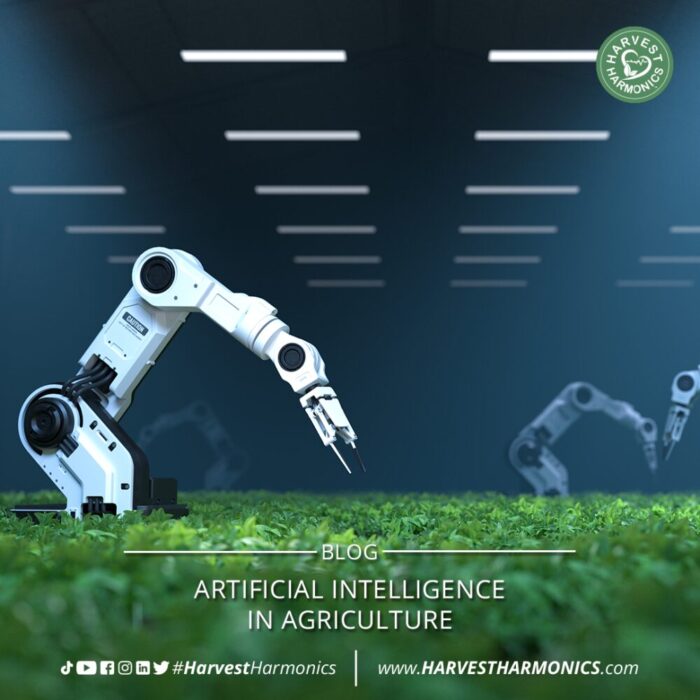
The technological revolution of recent years has also reached the agricultural sector to stay. More and more new ways of capturing information are being developed that, agronomically, can be of great interest to know the state of our farms and our crops. Artificial intelligence in agriculture allows knowing more data and adjusting all the tools more.
The sum of these two things means that we can adjust much more the amounts of phytosanitary products, fertilizers, the optimal point of harvest, pest control or water requirements.
In this article, we are going to learn a little more about artificial intelligence in agriculture, its main advantages and disadvantages, and some of the agricultural technological innovations that are coming onto the market.
What is artificial intelligence in agriculture?
Artificial intelligence (AI) applied in agriculture are all those capacities that a machine, sensor, monitor or computer is capable of performing with great precision, collecting a series of data that allow us to adjust and optimize any type of task and crop to the maximum.
There are many ways in agriculture where artificial intelligence is applied to obtain data and be able to analyze the different situations that arise with greater decision-making power. Let’s look at some examples:
Agricultural applications
Artificial intelligence has led to the development of several applications (apps) on agriculture. There are many examples related to apps on topics of agronomic interest.
Some allow us to manage farms from start to finish. Others are cartographic-type tools that allow us to measure the surfaces of the parcels and obtain geographic information about the area. There are also apps related to meteorology and also applications that allow you to manage an entire irrigation system using a mobile phone. All these applications simplify many tasks and time for farmers.
Sensors applied in agriculture
One of the tools that have been developed the most in recent years at the level of agro artificial intelligence are sensors. Sensors are used in all kinds of tools, cars, machines, etc. If we look at the use of sensors in agriculture, we can see advances in this aspect to improve the driving of tractors, tools and tanks to make applications. They are also used at a climatological level, with weather stations located at key points on farms and soil sensors that indicate both humidity and other key factors in soil fertility.
Aerial and satellite images
Apart from time management, organization and some technical parameters, artificial intelligence in agriculture applied in the field of aerial and satellite photos allows knowing the state of a crop, the amount of weeds or creating layers with the areas drier and more humid to adjust to the maximum the dose of irrigation necessary for the crop and within the same plot.
This artificial intelligence is used by taking aerial images using drones, such as the use of satellite photos.
Advantages and disadvantages of artificial intelligence applied to the agricultural industry
We have seen what artificial intelligence is and we have cited some practical examples of the number of things that can be done by applying AI in agriculture. Let us now see its main advantages and disadvantages:
Advantages
· Data: obtaining data allows greater decision-making power in a specific situation. Agriculture depends on many different factors, the more information we have, the greater control and power of decision and forecast we will have.
· Environmental and economic sustainability: the use of agro artificial intelligence allows us to adjust the doses of sowing, irrigation and phytosanitary products and fertilizers, which allows us to save a lot on phytosanitary products. This has a positive economic impact on our farm and the environment.
· Food safety: the control of all the processes, both in the field and post-harvest, allows exhaustive control of the traceability of the crops and their food safety.
Disadvantages
· Economic cost: although this is not always the case, applying artificial intelligence can sometimes be more expensive than the economic benefit it can bring you. Technology has advanced a great deal in recent years, but there is still technology that cannot be applied since its cost is greater than the benefit that ends up affecting the accounts of agricultural companies.
· Technology maintenance: maintenance is required on a regular basis in any type of sector. In the case of agriculture, technology is often exposed to different weather or adverse situations and inclement weather, so it requires greater attention and maintenance.
· Training: the use of artificial intelligence requires basic knowledge of technology.
If you would like to know more about our technology, contact us on our website www.harvestharmonics.com
Source: Agroptima
Press Room
Agricultural Technology for Farmers in India
Harvest HarmonicsTM New Biophysics Agricultural Technology For Farmers In India The Agricultural Biophysics technology, 20…
1
Organic Earth Tech, OETI, Launches One Million Dollar Technology
After hurricanes Maria and Irma, Puertorrican farmers are yet to receive the needed aid to recover. Organic Earth Tech…
0
Produce More From Less
CEO Harvest Harmonics Frank Arlia speaking at Replenish. Earth interview by Tia Kansara – London Climate Action Week. How…
0
Replenish Earth and the Environmental RE Talk Series
Replenish Earth and the environmental RE Talk Series event that reunited the top thinkers in the world Harvest Harmonics…
1
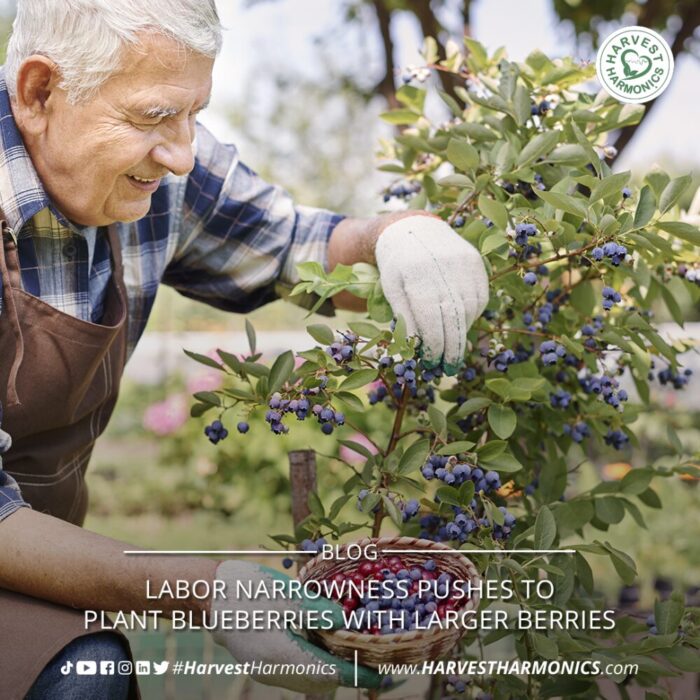
Labor Narrowness Pushes to Plant Blueberries with Larger Berries
The shortage of labor in the peak weeks of production is added as a factor to consumer requirements and has led companies such as Agrícola Cerro Prieto and Agrovision to incorporate the POP and Beauty varieties into their offer.
The Peruvian blueberry business continues to search for the best formula when choosing which varieties to include in its portfolio. And it is that, at the end of 2021, 60 varieties were counted, while in 2016 only 13 were registered, according to information from the Association of Blueberry Producers of Peru (Proarándanos). There are three criteria that guide the choice of producers, and that are becoming more and more relevant: the size of the berry, that the fruit has a less acid taste and that the berry has a good ‘crunch’, that is, firmness. This is related to the need to ensure the number of workers required in the campaign, especially at production peaks, and to meet consumer requirements regarding attributes such as flavor.
“It is becoming a challenge every time to get the volumes of people that are required, in some cases. People are paid per kilo harvested, if I have to harvest 1 kilo (kg) and my berries weigh 1 gram (g) it is 1,000 berries that I have to harvest, unlike if I have a fruit with double or triple of weight. It is more pleasant for the harvester and it yields more”, considers advisor Bruno Mancilla, from Consultora Santa María, a firm led by also advisor Sebastián Ochoa.
The agricultural export company Agrícola Cerro Prieto confirms that between weeks 37 and 40 there is a shortage of labor in Lambayeque. “In those weeks is where the majority of farms in this area are at peak production. People want to get to their goal quickly and have an extra. They no longer want to go to farms with a lot of Biloxi,” says their agricultural manager, Alfredo Chan Way. For example, if a worker can take out about 25,000 kilos/person in eight hours, with a larger-sized fruit he can take out around 80,000 kilos/person.
Agrícola Cerro Prieto has some 1,120 hectares of blueberries in Chiclayo. In addition, this year they will have significant production volumes of POP and Beauty. Currently, the main varieties of the firm are Biloxi, Ventura and Rocio.
In this context, the POP and Beauty varieties were born, both of which are part of Fall Creek’s Sekoya program. At least three companies have incorporated these varieties into their portfolio: Agrícola Cerro Prieto, Agrovision and Agroberries. «Today I have planted two important varieties: POP and Beauty. In other words, by 2022 I will have five varieties in major productions,” confirms Chan. The varieties stand out for their larger berries, their flavor and for having a good ‘crunch’. Firmness helps them to be travelers and arrive in optimal conditions to destinations such as China. Advisor Mancilla says that the ideal is to have blueberries about 16 to 18 millimeters. “You are looking for a large fruit, but not excessively large. A larger volume fruit always tends to soften faster”, he complements.
According to the advisor, it is not only important to obtain large berries, but also to have consistency. “The other important thing is that their caliber is sustained throughout the campaign, that they don’t fall. It happens to us many times, Ventura is starting with an average of 3g and at the end of the campaign he drops to 2.5g. Years ago Biloxi ended up with an average of 2 grams or 1.8 grams. This has led to the desire to search for better varieties,” explains Mancilla.
Both varieties stand out for their more pleasant flavor. According to the consultant Mancilla, the Peruvian industry is looking for a better flavor, since the berry tends to be acidic. “Perhaps many times in Peru one does not realize it, but the fruit from Mexico, the north of the US and Chile is sweeter. In the Peruvian case, there is no temperature differential day and night, which is decisive at the time of fruit ripening. On the coast of Peru, we have a temperature differential of 5° C, the fruit goes from being very acidic to being a flat fruit, which loses its flavor. Trying to raise brix degrees, the fruit is left on the plant for a longer time. That causes him to be physiologically overripe. For this reason, the blueberry harvest index is the color, not the brix,” explains Mancilla.
An Incipient Path
Currently, in Peru the predominant varieties are Biloxi and Ventura. In 2021, 3,291 ha of Biloxi, 2,748 ha of Ventura and 643 ha of Rocio were registered in La Libertad, the main blueberry producing area. But, the hectare of POP and Beauty was maintained, reaching 43.2 ha and 11.34 ha, respectively, last year. In the case of Lambayeque, last year some 1,447 ha of Ventura, 397 ha of Rocio, 350 ha of POP, 324 ha of Beauty and 231 ha of Biloxi were counted in order of importance, according to Proarándanos. The year-on-year increase in the area dedicated to these varieties
in the area is notable. Last year the producing areas of Ica and Ancash had, for the first time, the presence of both varieties.
Variation of the hectare of blueberries in Beauty
2020 2021
La Libertad 11,14 11,34
Lambayeque 34,29 324,29
Ica – 5,3
Ancash – 24,92
Source: Proarándanos
A unique flavor that is pleasant to the palate, together with the search for larger berries and traveling fruits, will continue to make a difference when choosing the best genetic material. The club of blueberry growers that has POP and Beauty is even smaller, but it is anticipated that more farmers will obtain the respective licenses over time. “I think these varieties will continue to grow. They are just entering Peru”, anticipates Mancilla. If you would like to know more about our technology, contact us on our website www.harvestharmonics.com
Source: Red Agrícola – Miriam Romainville Izaguir
Press Room
Agricultural Technology for Farmers in India
Harvest HarmonicsTM New Biophysics Agricultural Technology For Farmers In India The Agricultural Biophysics technology, 20…
1
Organic Earth Tech, OETI, Launches One Million Dollar Technology
After hurricanes Maria and Irma, Puertorrican farmers are yet to receive the needed aid to recover. Organic Earth Tech…
0
Produce More From Less
CEO Harvest Harmonics Frank Arlia speaking at Replenish. Earth interview by Tia Kansara – London Climate Action Week. How…
0
Replenish Earth and the Environmental RE Talk Series
Replenish Earth and the environmental RE Talk Series event that reunited the top thinkers in the world Harvest Harmonics…
1