

What is Spray Drift?
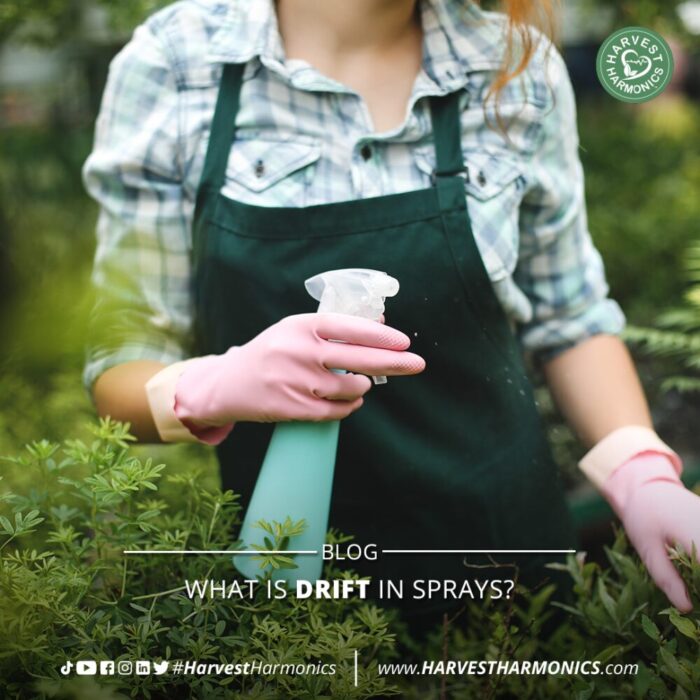
What is Drift?
Spray drift is a term used throughout the industry to describe the physical movement of pesticide droplets or particles through the air away from the planned target area. The droplets most likely to drift are those less than 150 microns in diameter.
The most determining factor is the wind speed
The greater the distance between the spray tip of the nozzle and the target area, the greater the impact of wind speed on droplet movement.
An increase in operating speeds can cause the wind to return in the form of vortex-type overhead currents behind the sprayer, trapping small droplets and thus contributing to drift.
When temperatures are above 25ºC and relative humidity is low, small droplets are more likely to drift, due to the effects of evaporation.
Low dosages generally require the use of small nozzles, which increases the risk of loss.
The smaller the nozzle size and the higher the spray pressure, the smaller the droplet size and the greater the proportion of droplets likely to drift.
Useful tips to control drift
Reduce the working pressure to increase the size of the drops. Due to the decrease in flow rate, it may be necessary to use larger nozzles to stay within the dosage indicated on the product label.
Use nozzles that produce larger droplets, such as low drift nozzles or higher capacity nozzles.
Decrease boom height to reduce losses, while maintaining adequate overlap to ensure desired spray coverage.
Causes of spray drift
A number of variables contribute to spray droplet losses; these are mainly due to the spray equipment system and weather factors.
Drop size
Within the spray equipment system, droplet size is the most influential factor. When a liquid solution is sprayed under pressure, it atomizes into droplets of various sizes: The smaller the nozzle size and the higher the spray pressure, the smaller the droplets and thus the greater the proportion of droplets with a tendency to drift.
Spray height
As the distance between the nozzle and the target increases, the greater the impact that wind speed can have. The influence of the wind can increase the proportion of smaller droplets deflected from the target and considered as lost.
Working speed
Increased operating speeds can cause spray to drift into updrafts and vortices behind the sprayer, which traps fine droplets and can contribute to drift. Ideally, apply chemicals according to good professional practice at maximum working speeds of 6 to 8 km/h (with air induction nozzles – up to 10 km/h). As wind speeds increase, reduce working speed.
Wind speed
Among the meteorological factors that affect drift, the one with the greatest impact is wind speed. Increasing wind speed increases drift. Therefore, it is important to carry out spraying operations during relatively calm hours of the day. Generally, early morning and late afternoon are the quietest hours.
Some recommendations when spraying
In low wind speed situations, spraying can be done at recommended nozzle pressures.
As wind speeds increase to 3 m/s, spray pressure will need to be reduced and nozzle size increased to obtain larger droplets that are less prone to drift. Wind measurements should be taken during the spraying operation using an anemometer or wind gauge. As the risk of drift increases, it is very important to choose spray tips with coarser droplets that are less prone to drift.
When wind speeds exceed 5 m/s, spraying should be stopped.
Environmental temperature and humidity
At ambient temperatures above 25°C with low relative humidity, small droplets are especially prone to drift due to the effects of evaporation.
If you would like to know more about our technology, contact us on our website www.harvestharmonics.com
Source: https://www.unicoop.com.py/
Press Room

Agricultural Technology for Farmers in India
Harvest HarmonicsTM New Biophysics Agricultural Technology For Farmers In India The Agricultural Biophysics technology, 20…
1

Organic Earth Tech, OETI, Launches One Million Dollar Technology
After hurricanes Maria and Irma, Puertorrican farmers are yet to receive the needed aid to recover. Organic Earth Tech…
0

Produce More From Less
CEO Harvest Harmonics Frank Arlia speaking at Replenish. Earth interview by Tia Kansara – London Climate Action Week. How…
0

Replenish Earth and the Environmental RE Talk Series
Replenish Earth and the environmental RE Talk Series event that reunited the top thinkers in the world Harvest Harmonics…
1
Related Posts
2024 India Just Agriculture Frank’s presentation
https://www.youtube.com/watch?v=g_4vdtXBVsA&ab_channel=HarvestHarmonics The Crop Booster by Kyminasi Plants consists of...
Water II
"There is nothing softer and weaker than water, and yet there is nothing better for attacking hard and strong things." The Chinese sage Lao...
Water
The Memory of Water The reason the Kyminasi Plant Booster works so well is because water has memory, and we can use this to relay our...