The Importance of Technology in Sustainable Agriculture
Nowadays, agriculture faces the great challenge of increasing productivity due to the rising demand of food worldwide. The efficiency in hydric and natural resources usage, climate change adaptation, respecting of the environment where the crops will take place, and the farmer’s cooperation within the decision-making process are a set of factors that, if executed correctly, will allow a sustainable agriculture overtime.
A crucial element is working with the production systems on their different stages and, especially, where raw material is found: the field. It is here where an emphasis on improving production should be.
Productivity’s dropage can be related to various aspects, like plants’ poor management in trimming or crop varieties that couldn’t adapt to the ground. Irrigation is a key factor too: more watering does not mean better crops. Likewise, extreme fertilization is deteriorating the yield’s soil and often destroys all life surrounding the plant’s environment, stalling its growth and development, as well as plagues, which can affect and usually end with farming production. A farmer can work with and control all of these elements through sustainable agriculture and adding technology to the field.
It doesn’t just go through a clearly “ground” or field subject, this agriculture must manage to protect the rural life of those who work in it and the social welfare. Having a work environment in the farming industry with the field worker will allow access to excellent results. This social responsibility is like a backpack that our line of work has been enhancing and giving space to in traditional agriculture.
In order to address and improve these matters, it must be managed hand by hand with technology. There is no agriculture that lasts in time without superior technology in their course of action, it has to be an ally with the purpose of increasing our planet’s crops.
With this idea in mind, Kyminasi Plant Booster technology takes place and Harvest Harmonics company is in charge of distributing it: to reach a sustainable agriculture, allowing the farmer to have vigorous and profitable crops in short and medium terms while taking care of the environment in which they develop.
By Arantza Castro
Press Room

Agricultural Technology for Farmers in India
Harvest HarmonicsTM New Biophysics Agricultural Technology For Farmers In India The Agricultural Biophysics technology, 20…
1

Organic Earth Tech, OETI, Launches One Million Dollar Technology
After hurricanes Maria and Irma, Puertorrican farmers are yet to receive the needed aid to recover. Organic Earth Tech…
0
Produce More From Less
CEO Harvest Harmonics Frank Arlia speaking at Replenish. Earth interview by Tia Kansara – London Climate Action Week. How…
0

Replenish Earth and the Environmental RE Talk Series
Replenish Earth and the environmental RE Talk Series event that reunited the top thinkers in the world Harvest Harmonics…
1

Biophysics of the Plant Kingdom
Biophysics is a science in which biology and physics converge, thus explaining biological processes complicated with physical phenomenon. In 1920, it questioned because biological systems do not follow the second law of thermodynamics but in a world where entropy never decreases, two cells could form an organism fully organized. Furthermore, Schrödinger wrote his book called What is Life, which form many, was the beginning of
Biophysics is present in each of the existing living beings, one of the most complex kingdoms is the plant, which has proven to have an infinite variety of permutations, and so studying it completely is almost impossible. Biophysics in plants is consider
In short, a plant formed of a root, a stem and leaves. The root absorbs nutrients from the soil through a permeable membrane, the stem is responsible for transport by microscopic tubes and the leaves are responsible for photosynthesis through a complex system of chromophores for the exchange of gases. The simple biophysical model of a plant is expressed as a capillary tube, with one end submerged in a solution delimited by a selective membrane and the opposite end in free contact with the atmosphere.

Due to osmosis, when there is a difference in gradient the water and nutrients flow from the root to the highest point of the plant where there will always be the lowest concentration of solutes. Due to the gradient, the plant will have moments of imbalance so through physiological mechanisms of the plant; roots adapt to rebalance the natural state of the plant.
At microscopic scales, the vibrations emitted by electrons make it possible to recognize any substance. These vibrations are fingerprints and are thus a highly reliable factor in scientific and industrial matters. Kyminasi Plant Booster recognizes each frequency emitted by the plants and intervenes resonance reaching the optimal frequency thus giving biological balance.
Biological balance allows plants to develop in a healthy way, without stress and with better results in quality and quantity, all this in an organic and sustainable way.
By Maria Belén Amaguaña
Press Room

Agricultural Technology for Farmers in India
Harvest HarmonicsTM New Biophysics Agricultural Technology For Farmers In India The Agricultural Biophysics technology, 20…
1

Organic Earth Tech, OETI, Launches One Million Dollar Technology
After hurricanes Maria and Irma, Puertorrican farmers are yet to receive the needed aid to recover. Organic Earth Tech…
0

Produce More From Less
CEO Harvest Harmonics Frank Arlia speaking at Replenish. Earth interview by Tia Kansara – London Climate Action Week. How…
0

Replenish Earth and the Environmental RE Talk Series
Replenish Earth and the environmental RE Talk Series event that reunited the top thinkers in the world Harvest Harmonics…
1

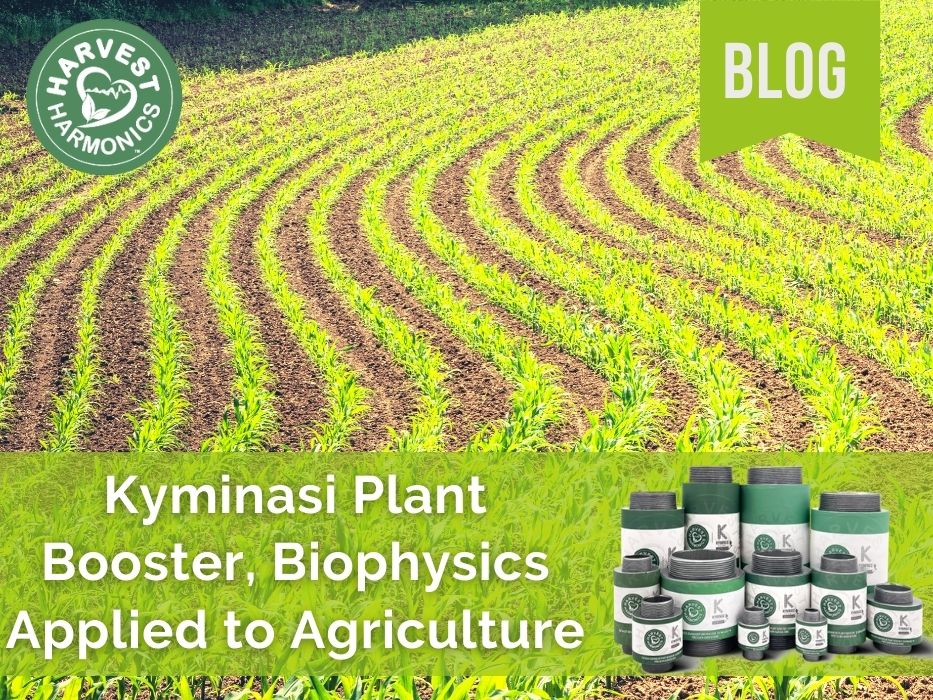
Kyminasi Plant Booster, Biophysics Applied to Agriculture
Any adverse effects including negative leaf water balance, turgor loss, chlorophyll degradation, and down-regulation of photosynthesis through affecting stomatal functioning and restricting the supply of carbon dioxide (Zhou et al. 2017). Cell enlargement, leaf expansion, root and shoot development, dry matter partitioning, and consequently yield are also negatively influenced by drought stress (Farooq et al. 2009). Up to the present, a great number of investigations have been conducted to develop strategies to help plants to cope with drought stress (Aliniaeifard and Van Meeteren 2016a, b; Lastochkina et al. 2019; Khan et al. 2020).
In California, there were no major issues during planting, but higher than average temperatures in late spring affected early crop yields. Inconsistent weather patterns throughout the growing season prompted short interruptions in the flow of ripe tomatoes. Wildfires that raged through the state in late summer and early fall slowed the processing of tomato harvest. Crop quality varied by region and disease pressure was low. Due to a lack of rain, water availability continued to be a concern.
Approximately 90% of California tomatoes are grown in groundwater sub-basins (Fig. 1) that are classified as high priority or critically over-drafted. Restrictions on groundwater pumping under Sustainable Groundwater Management Act will increase competition for water, which increases the cost of water to growers in those regions and increases tomato production costs by USD 75 to USD 235 per acre, or 3% to 7%, depending on production region.
The processing tomato industry requires a material with favorable dry matter content to keep the cost of water evaporation as low as possible during the preparation of the pulp. The main fraction of this dry matter content in tomato fruits comprise the soluble solids content, expressed in °Brix it is highly influenced by the natural or artificial water supply If there are no reduce costs market prices would vary by region, which would affect crops that could be profitably irrigated.
Research developed on the effect of water stress on tomato plants reported that it had no effects on acidity levels and Total Solids Suspended. Saito et al. (2008) reported that the °Brix value increased in tomatoes under salt stress and, tricarboxylic acid levels of stress-treated fruit was also 1.6 times higher than that of the control and would affect the total acidity of tomato fruit. Mitchell et al. (1991) reported that the water-soluble solid content increased in tomato plants that were grown in limited water conditions because when water was scarce, the organic soluble dry substance synthesis and accumulation increased.
By Arantza Castro
Press Room

Use of Sound Wave Technology on Water Tomato Scarcity
Tomato (Solanum Lycopersicum), with annual global production of around 182.3 million tons, is the second top worldwide produced vegetable, also is among the most popular vegetable produced in the United States of America (USA) where the topmost producers are Indiana, Florida, and California, besides the tomatoes being sold in the fresh vegetable markets, a large portion of the tomatoes is processed as sauces, paste, canned whole tomatoes, ketchup, and juice.
California State produces 255,388 thousand centum weight of tomatoes each year consequently, it is the highest producer of tomatoes in the USA and among the highest tomato producers in the world. More specifically, approximately one-third of the world’s tomatoes and 95% of the United States’ tomatoes are produced in California.
Tomato is not a very tolerant plant in response to many abiotic stress conditions and its growth and productivity are limited by unfavorable environmental conditions such as drought and salinity (Dong et al. 2020). Drought stress causes many adverse effects including negative leaf water balance, turgor loss, chlorophyll degradation, and down-regulation of photosynthesis through affecting stomatal functioning and restricting the supply of carbon dioxide (Zhou et al. 2017). Cell enlargement, leaf expansion, root and shoot development, dry matter partitioning, and consequently yield are also negatively influenced by drought stress (Farooq et al. 2009). Up to the present, a great number of investigations have been conducted to develop strategies to help plants to cope with drought stress (Aliniaeifard and Van Meeteren 2016a, b; Lastochkina et al. 2019; Khan et al. 2020).
In California, there were no major issues during planting, but higher than average temperatures in late spring affected early crop yields. Inconsistent weather patterns throughout the growing season prompted short interruptions in the flow of ripe tomatoes. Wildfires that raged through the state in late summer and early fall slowed the processing of tomato harvest. Crop quality varied by region and disease pressure was low. Due to a lack of rain, water availability continued to be a concern.
Approximately 90% of California tomatoes are grown in groundwater sub-basins (Fig. 1) that are classified as high priority or critically over-drafted. Restrictions on groundwater pumping under Sustainable Groundwater Management Act will increase competition for water, which increases the cost of water to growers in those regions and increases tomato production costs by USD 75 to USD 235 per acre, or 3% to 7%, depending on production region.
The processing tomato industry requires a material with favorable dry matter content to keep the cost of water evaporation as low as possible during the preparation of the pulp. The main fraction of this dry matter content in tomato fruits comprise the soluble solids content, expressed in °Brix it is highly influenced by the natural or artificial water supply If there are no reduce costs market prices would vary by region, which would affect crops that could be profitably irrigated.
Research developed on the effect of water stress on tomato plants reported that it had no effects on acidity levels and Total Solids Suspended. Saito et al. (2008) reported that the °Brix value increased in tomatoes under salt stress and, tricarboxylic acid levels of stress-treated fruit was also 1.6 times higher than that of the control and would affect the total acidity of tomato fruit. Mitchell et al. (1991) reported that the water-soluble solid content increased in tomato plants that were grown in limited water conditions because when water was scarce, the organic soluble dry substance synthesis and accumulation increased.
Figure1. Map of water scarcity across the California state and zones with different drought intensity. The location of most tomato production and processors is in the San Joaquin Valley in water-stressed areas. (Adapted from: https://www.farmwater.org/cfwc-blog/ and https://droughtmonitor.unl.edu/)
Both under- and over-irrigation can cause inadequacy in crop yield to find the optimal water supply level can save water and may provide yield quantity and quality. Lowers levels of water stress can affect yields positively thus, measuring and monitoring water stress is the key to its control and the appropriate amount the plants should be exposed to can enhance the production of desirable compounds that make it healthier for consumers and profitable for producers.
In our experience fields irrigated under the effects of Kyminasi Plant Booster technology show a reduction in water use and better rates of infiltration. From November 2020 a field in Paine – Chile was irrigated and monitored with soil moisture capacitance sensors, previous information about the rate of water infiltration was 40 centimeters in 12 hours; now under the effect of Kyminasi Plant Booster technology the rate of water infiltration is 100 centimeters in 10 hours, showing a three-time more quick water infiltration rate with 66% of water-saving.
Figure 2. Water infiltration results: on the upper (A) graph the previous conditions low and slow infiltration rate, bottom graph (B) show faster and deep infiltration rate after Kyminasi Plant Booster technology use
Climate change scenarios predict restriction in water supply shortly, but large parts of the world already suffer from the deficiency of water in agriculture as we show in other publications plants perceive sound waves as a type of external signal similar to biotic or abiotic stress stimuli, the response to such stimuli is the biosynthesis of secondary metabolites, including ascorbic acid, flavonoids, and other compounds that may have protective effects (i.e., antioxidant or antimicrobial occupations). The concentrations of these compounds increased in response to external stimuli such as light, ultraviolet radiation, temperature, ozone, heavy metals, and drought conditions (Mierziak. et.al 2014., Lim et.al 2017).
Although the use of the Kyminasi Plant Booster technology does not prevent or allow to control the damage caused by extreme environmental events due to water scarcity or climate change it has demonstrated effects on water use related directly to production per plant with higher quality in terms of dissolved solids content.
Kyminasi Plant Booster provides producers of Tomato and other important crops in agriculture clean and safe use technology with the low environmental impact that improves cycling and availability of nutrients in the soil, reduces the use of water for irrigation, and strengthens the resistance of the plants against stress factors, enhance chemical-free production systems, with better phytosanitary conditions that represent health benefits for consumers and better income for producers.
By Leonardo Martinez, Harvest Harmonics Field Researcher South America.
LinkedIn: Leonardo Martinez Luque
Twitter: @leonemil
Fernandez-Jaramillo, A.A., Duarte-Galvan, C., Garcia-Mier, L., Jimenez-Garcia, S.N., Contreras-Medina, L.M. 2018. Effects of acoustic waves on plants: An agricultural, ecological, molecular and biochemical perspective. Scientia Horticulturae, Volume 235, Pages 340-348. https://doi.org/10.1016/j.scienta.2018.02.060. Kasler, D. 2021. California, get ready for water cutbacks. Cities, farms receive grim warning about supply. The Sacramento Bee. https://www.sacbee.com/news/california/water-and-drought/article250145884.html Lahoz, I., Pérez-de-Castro, A., Valcárcel, M., Macua, J.I., Beltrán, J., Roselló, S., Cebolla-Cornejo, J. 2016. Effect of water deficit on the agronomical performance and quality of processing tomato, Scientia Horticulturae, Volume 200, Pages 55-65. https://doi.org/10.1016/j.scienta.2015.12.051. Lim SH, Kim DH, Kim JK, Lee JY and Ha SH. 2017. A radish basic helix-loop-helix transcription factor, RsTT8 acts a positive regulator for anthocyanin biosynthesis. Front Plant Sci 8:1917Mierziak J, Kostyn K and Kulma A. 2014. Flavonoids as important molecules of plant interactions with the environment. Molecules 19:16240–16265.
Press Room

Sound Waves Effects on Tomato Fruit Quality
Sound Waves Effects on Tomato Fruit Quality Tomatoes are one of the most produced and consumed fruit worldwide, it is considered an important source of phenolic and flavonoid antioxidant compounds, vitamin C, vitamin E, lycopene, carotene, and lutein contents critical for human health due to their effects on cancer and aging. The United States produces […]
Alternatives for Fighting Citrus Greening Disease
Plants respond to sounds of different frequencies Florida State is the third-largest orange producer globally, behind Brazil and China, and the first orange-producing in the United States. The 2020 – 2021 forecast released by the USDA Agricultural Statistics Board this month calculates over 55.5 million boxes, down from the February forecast by 500 thousand boxes; […]
Effects of frequencies on plants
Plants respond to sounds of different frequencies Sound is acoustic energy in an oscillatory pressure wave transmitted through gases, liquids, and solids. Like other physical environmental factors such as moisture, light, wind, and temperature, it can have a physiological effect on plant growth and other metabolic processes, or at a molecular level-triggered within a plant […]
How to Face the Challenges in Sweet Pepper Production
Effect of Electromagnetic Fields on Growth and Yield: A Review Despite the turbulent economic issues agriculture has gone through these past years, the cultivation of bell peppers remain strengthened in the regions with the highest production such as Mexico and the United States; however, as a collateral effect of the pandemic, market quotas face drastic […]
Florida’s Winter Strawberries
The most important supplier of winter strawberries in the United States Florida is the most important supplier of winter strawberries in the United States and the second-largest after California. The value of Florida strawberries production is approximately $400 Million and the total economic contribution of the industry is estimated at more than One Billion. Even […]
Effect of Electromagnetic Fields on Growth and Yield: A Review
Effect of Electromagnetic Fields on Growth and Yield: A Review All living things that grow on the earth are affected by natural Magnetic Fields; it is helpful to think of radiation in terms of particles or waves just like the ones we see in the water, such as radio waves, microwaves, infrared, visible light, ultraviolet […]